Public Safety Canada Quarterly Financial Report for the quarter ended December 31, 2025
Table of contents
- 1.0 Introduction
- 2.0 Highlights of fiscal quarter and fiscal year-to-date (YTD) results
- 3.0 Risks and uncertainty
- 4.0 Significant changes in relation to operations, programs and personnel
- 5.0 Approval by senior officials
- 6.0 Statement of authorities (unaudited)
- 7.0 Departmental budgetary expenditures by standard object (unaudited)
1.0 Introduction
This quarterly financial report for the period ending December 31, 2025 has been prepared by management as required by section 65.1 of the Financial Administration Act, in the form and manner prescribed by Treasury Board. The report should be read in conjunction with the Main Estimates.
This report has not been subject to an external audit or review. However, it has been reviewed by the Departmental Audit Committee prior to approval by the Deputy Minister.
Information on the mandate, roles, responsibilities and programs of Public Safety Canada can be found in the 2025-26 Departmental Plan and the 2025-26 Main Estimates.
1.1 Basis of presentation
This quarterly report has been prepared using an expenditure basis of accounting. The accompanying Statement of authorities table includes the Department's spending authorities granted by Parliament, or received from Treasury Board Central Votes, and those used by the Department consistent with the Main Estimates and Supplementary Estimates (B) for the 2025-26 fiscal year. This report has been prepared using a special purpose financial reporting framework designed to meet the information needs concerning the use of spending authorities.
The authority of Parliament is required before funds can be spent by the Government. Approvals are given in the form of annually approved limits through Appropriation Acts or through legislation in the form of statutory spending authority for specific purposes.
Public Safety Canada uses the full accrual method of accounting to prepare and present its annual departmental financial statements that are part of the departmental performance reporting process. However, the spending authorities voted by Parliament remain on an expenditure basis, as do the expenditures presented in this report.
2.0 Highlights of fiscal quarter and fiscal year-to-date (YTD) results
The following graph provides a comparison of the net budgetary authorities and expenditures as of December 31, 2025 and December 31, 2024 for the Department's combined:
- Vote 1 – Operating expenditures
- Vote 5 – Grants and contributions
- Statutory Votes:
- Employee Benefit Plans
- Minister's Salary and Car Allowance
The net budgetary authorities have decreased by $235.8 million (9.6 percent), primarily due to additional funding that was received in 2024-25 for the Disaster Financial Assistance Arrangements (DFAA), which does not reoccur in 2025-26. Furthermore, expenditures to date are $115.5 million (15.8 percent) lower compared to the same period last year, largely attributable to lower payments of various transfer payments.
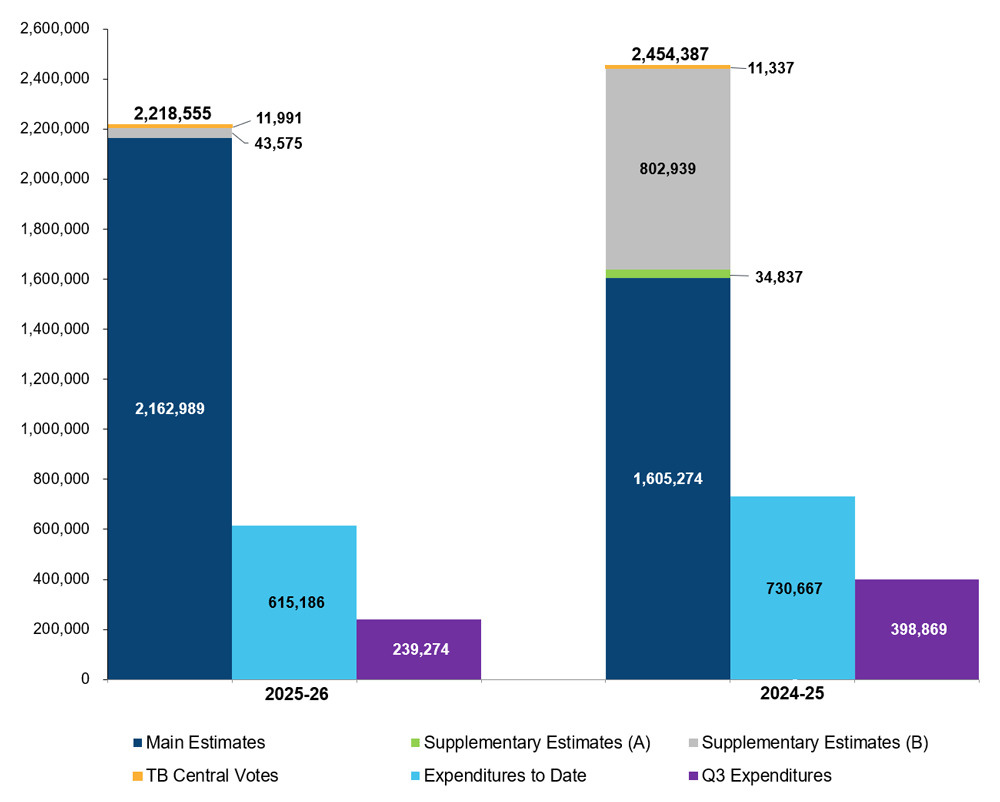
Figure 1: Image description
Starting from the left-hand side, the first column in the graph indicates that the Department's authorities amount to $2,218,555 thousand for fiscal year 2025-26. The year-to-date expenditures of $615,186 thousand reported at the end of the third quarter of the 2025-26 fiscal year are shown under the second column. The expenditures of $239,274 thousand for the period ended December 31, 2025 (i.e. third quarter) are presented under the third column. The fourth column in the graph depicts the 2024-25 authorities, which were at $2,454,387 thousand at the end of December 2024. The 2024-25 year-to-date expenditures of $730,667 thousand reported at the end of the third quarter of the 2024-25 fiscal year are shown under the fifth column. The Department's actual expenditures incurred in the third quarter of fiscal year 2024-25 were $398,869 thousand and are shown under the sixth column of the graph.
The following graph provides a comparison between the total of Vote 1 – Operating expenditures, Vote 5 – Grants and contributions, and Statutory funding (Employee Benefit Plans and Minister's Salary and Car Allowance) as of December 31, 2025 and December 31, 2024. The total of Vote 1 – Operating expenditures as of December 31, 2025 includes funding received through Main Estimates ($346.7M), Supplementary Estimates (B) ($8.8M) as well as TB Central Vote ($11.6M for the operating budget carry forward and $0.4M for compensation adjustments).
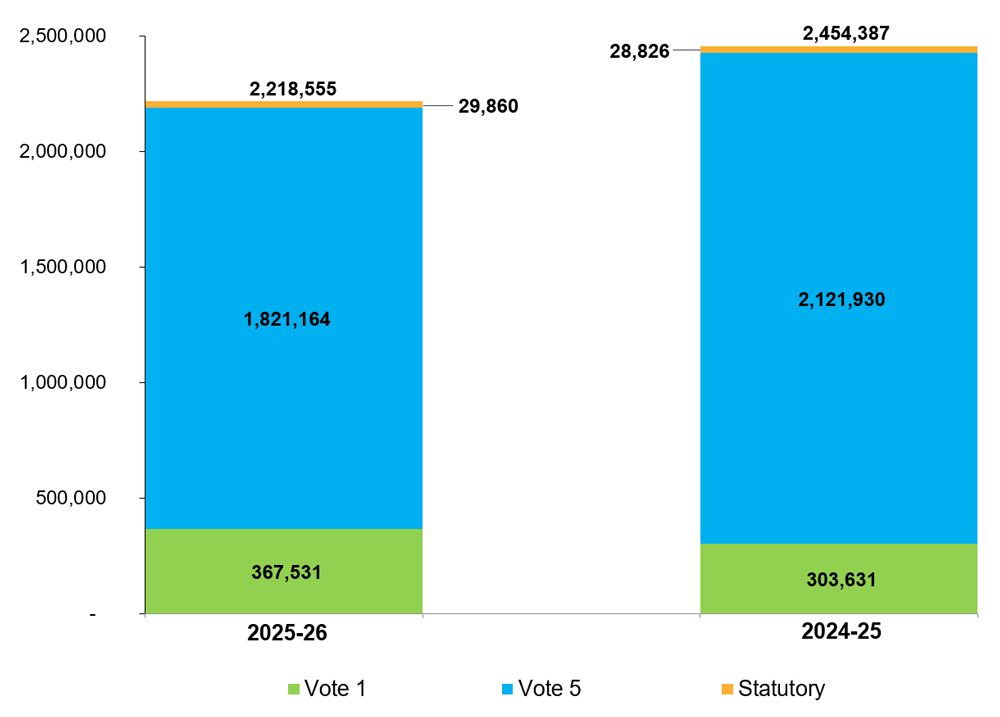
Figure 2: Image description
Starting from the left-hand side, the first column in the graph indicates that the Department received $2,218,555 thousand in funding through Main Estimates, Supplementary Estimates (B) and Treasury Board Central Vote transfers for fiscal year 2025-26. This total includes $367,531 thousand in Vote 1, $1,821,164 thousand in Vote 5 and $29,860 thousand in Statutory funding. The second column in the graph depicts the 2024-25 funding received through Main Estimates, Supplementary Estimates (A), Supplementary Estimates (B) and Treasury Board Central Vote transfers which amounted to $2,454,387 thousand. The total for 2024-25 includes $303,631 thousand in Vote 1, $2,121,930 thousand in Vote 5 and $28,826 thousand in Statutory funding.
2.1 Significant changes to authorities
For the period ending December 31, 2025, the authorities provided to the Department include Main Estimates, Supplementary Estimates (B) and TB Central Vote transfers. The 2024-25 authorities for the same period included the Main Estimates, Supplementary Estimates (A), Supplementary Estimates (B) and TB Central Vote transfers. The Statement of authorities table (Section 6.0) presents a decrease of $235.8 million (9.6 percent) compared to those of the same period of the previous year (from $2,454.4 million to $2,218.6 million).
Operating expenditures authorities (Vote 1) have increased by $63.9 million (21.0 percent) (from $303.6 million to $367.5 million), which is primarily attributable to:
- An increase of $61.9 million in funding for the Assault-Style Firearms Compensation Program (ASFCP). This is explained by an increase of $86.6 million in new funding required to implement the individuals phase of the program and completing the collection and destruction of individually owned assault-style firearms. This increase is offset by a decrease of $24.7 million in funding levels related to the business phase of the program including funding related to planning and operational functions, to fully implement a web portal and case management system and to support a national marketing campaign;
- An increase of $4.3 million related to one-year funding for safety-related expenses for Canada's 2025 G7 Presidency;
- An increase of $3.7 million related to the Operating Budget Carry Forward (OBCF);
- An increase of $3.4 million in new funding to enhance the integrity of Canada's Borders;
- An increase of $2.9 million in new funding to support First Nations and Inuit police services; and
- An increase of $2.7 million in new funding for the National Cyber Security Strategy.
These increases are primarily offset by the following decreases:
- A decrease of $10.9 million in capital funding required for the relocation and accommodations for the Government Operations Center (GOC) (Budget 2016); and
- A decrease of $3.3 million in funding for the Enhance Natural Disaster Resilience initiative.
Grants and contributions (G&C) authorities (Vote 5) have decreased by $300.7 million (14.2 percent) (from $2,121.9 million to $1,821.2 million), which is primarily attributable to:
- A decrease of $734.0 million related to the Disaster Financial Assistance Arrangements (DFAA) program is attributable to a $208.9 million reduction in funding to support the 2021 natural disasters in British Columbia, as well as a decrease of $525.1 million in funding levels required for fiscal year 2025-26;
- A decrease of $25.5 million following the expiry of reprofiled funding in 2024-25 for the Building Safer Communities Fund; and
- A decrease of $14.6 million in funding due to the sunset of funding for the Drug Impaired Driving initiative.
These decreases are primarily offset by the following increases:
- An increase of $319.2 million in funding for the Assault-Style Firearms Compensation Program (ASFCP) which is due to an increase of $314.6 million in new funding for the collection and destruction of individually-owned assault-style firearms related to the individuals phase of the ASFCP as well as to provide compensation to firearm owners covered by the program. This increase is also explained by an increase of $4.6 million in funding required to compensation for the businesses phase of the program;
- An increase of $52.8 million related to one-year funding for safety-related expenses for Canada's 2025 G7 Presidency;
- An increase of $46.0 million in funding for the First Nations and Inuit Policing Facilities Program;
- An increase of $30.2 million in funding for the First Nations and Inuit Policing Program;
- An increase of $18.8 million to Address Post-Traumatic Stress Injuries (PTSI) primarily attributable to a transfer in 2024-25 to the Department of Health to support Ontario in providing mental health support for frontline health workers and first responders; and
- An increase of $10.0 million in new funding to enhance security around parliamentary campus.
Budgetary statutory authorities have increased by $1.0 million (3.6 percent) in 2025-26 primarily attributable to the Employee Benefits Plan associated with new salary funding received in the Main Estimates and the Supplementary Estimates (B).
2.2 Significant variances from previous year expenditures
Year-to-date expenditures
For the period ending December 31, 2025, the Departmental budgetary expenditures by standard object table (Section 7.0) presents a decrease of $115.5 million (15.8 percent) in Public Safety's year-to-date (YTD) expenditures compared to the previous year (from $730.7 million to $615.2 million).
Personnel expenditures have increased by $22.6 million (14.7 percent), primarily due to an increase in staffing requirements to support the advancement of the department's agenda as well as to cover compensation adjustments associated with concluded collective agreements, and updated terms and conditions of employment.
Operating expenditures have increased by $5.4 million (13.1 percent), primarily attributable to increased costs associated with professional services and information technology (IT) services and equipment. This increase is partially offset by a decrease in expenses for the Government Operations Center (GOC) accommodations project.
Transfer payment expenditures have decreased by $142.4 million (26.5 percent) primarily attributable to:
- a decrease of $181.5 million in support of payments for the Disaster Financial Assistance Arrangements (DFAA) program;
- a decrease of $16.6 million due to the timing of payments for the Initiative to Take Action against Gun and Gang Violence; and
- a decrease of $6.0 million due to the timing of payments for the National Crime Prevention Strategy.
Primarily offset by the following increases:
- an increase of $35.1 million in support of payments for the First Nations and Inuit Policing Program;
- an increase of $7.7 million in support of payments for the First Nations and Inuit Policing Facilities Program;
- an increase of $6.8 million in support of payments for the Assault-Style Firearms Compensation Program (ASFCP);
- an increase of $5.8 million due to the timing of payments for the Biology Casework Analysis Program; and
- an increase of $4.6 million due to the timing of payments for the Building Safer Communities Fund.
Third quarter expenditures
Compared to the previous year, expenditures used during the quarter ended December 31, 2025 have decreased by $159.6 million (40.0 percent) (from $398.9 million to $239.3 million) as reflected in the Departmental budgetary expenditures by standard object table (Section 7.0).
Personnel expenditures have increased by $9.2 million (17.7 percent), primarily due to new collective agreements and an increase in staffing requirements to support the advancement of the department's agenda.
Operating expenditures have decreased by $3.0 million (15.6 percent), primarily due to a decrease in spending for the Government Operations Centre (GOC) repairs and maintenance as well as for the department's expenditures for professional services.
Transfer payment expenditures have decreased by $165.0 million (50.4 percent) primarily attributable to:
- a decrease of $184.9 million in support of payments for the Disaster Financial Assistance Arrangements (DFAA) program;
- a decrease of $9.6 million due to the timing of payments to support the Canadian Red Cross's Urgent Relief Efforts – Donation Matching program; and
- a decrease of $5.7 million due to the timing of payments for the Memorial Grant for First Responders Program.
Primarily offset by the following increases:
- an increase of $21.3 million in support of payments for the First Nations and Inuit Policing Program;
- an increase of $6.1 million due to the timing of payments for the Building Safer Communities Fund; and
- an increase of $5.8 million due to the timing of payments for the Biology Casework Analysis Program.
3.0 Risks and uncertainty
Disaster Financial Assistance Arrangements
The Disaster Financial Assistance Arrangements (DFAA) contribution program presents a greater level of uncertainty than other Public Safety Canada grants and contributions programs given that it represents a significant portion of the Public Safety Canada budget and that it is subject to unforeseen events. The DFAA contribution program was established in 1970 to provide a consistent and equitable mechanism for federal sharing of provincial and territorial costs for natural disaster response and recovery where such costs would place an undue burden on a provincial or territorial economy.
There are currently 89 active natural disasters for which Orders in Council (OiC) have been approved, authorizing the provision of federal financial assistance under the DFAA, and for which final payments have not yet been made. Public Safety's total outstanding share of liability under the DFAA with regard to these 89 events is $4.40 billion, the majority of which is expected to be paid out over the next five years.
DFAA liability has slightly decreased by $0.12 billion from $4.52 billion in the second quarter of 2025-26 to $4.40 billion in the third quarter of 2025-26. Variations in the DFAA liability are mainly attributable to:
- Changes for newly approved OiCs, which authorize funding related to recent natural disasters for which provinces and territories require federal sharing of costs;
- Changes in the estimates of the existing natural disasters; and
- Changes for payments issued under the existing obligation.
The following are the most significant events within Public Safety Canada's DFAA liability:
- British Columbia 2021 November Storm ($1.2 billion)
- Alberta 2013 June Flood ($410 million)
- Manitoba 2022 Spring Flood ($275 million)
- British Columbia 2020 Flood & Landslides ($274 million)
- British Columbia 2021 Wildfire ($190 million)
- Quebec 2019 Spring Flood ($183 million)
- British Columbia 2023 Interface Fires ($177 million)
- British Columbia 2017 July Wildfire ($160 million)
Updates to the DFAA liability as a result of changes to the estimates of the existing natural disasters, are completed and approved once a month with the last update having been conducted in November 2025 and is reflected in the current Quarterly Financial Report.
4.0 Significant changes in relation to operations, programs and personnel
The following organizational change took place during the third quarter of 2025-26:
Karine Paré was appointed as Assistant Deputy Minister, Corporate Management Branch (CMB) and Chief Financial Officer, effective December 4, 2025.
5.0 Approval by senior officials
Approved as required by the Policy on Financial Resource Management, Information and Reporting:
Tricia Geddes
Deputy Minister
Public Safety Canada
Ottawa (Canada)
Date: February 26, 2026
Karine Paré, CPA
Chief Financial Officer
Public Safety Canada
Ottawa (Canada)
Date: February 20, 2026
6.0 Statement of authorities (unaudited)
| Authorities | Total available for use for the year ending March 31, 2026Footnote 1 | Used during the quarter ended December 31, 2025 | Year-to-date used at quarter-end |
|---|---|---|---|
| Vote 1 – Net Operating Expenditures | 367,530,761 | 69,466,269 | 197,255,738 |
| Vote 5 – Grants and contributions | 1,821,163,803 | 162,596,848 | 396,276,071 |
| Employee Benefit Plans (EBP) | 29,758,228 | 7,172,672 | 21,518,014 |
| Minister's Salary and Motor Car Allowance | 102,300 | 38,500 | 135,867 |
| Total Authorities | 2,218,555,092 | 239,274,289 | 615,185,690 |
| Authorities | Total available for use for the year ending March 31, 2025Footnote 1 | Used during the quarter ended December 31, 2024 | Year-to-date used at quarter-end |
|---|---|---|---|
| Vote 1 – Net Operating Expenditures | 303,630,785 | 65,624,805 | 175,631,849 |
| Vote 5 – Grants and contributions | 2,121,929,941 | 327,626,224 | 538,164,129 |
| Employee Benefit Plans (EBP) | 28,727,650 | 5,601,602 | 16,804,804 |
| Minister's Salary and Motor Car Allowance | 98,600 | 16,466 | 65,866 |
| Total Authorities | 2,454,386,976 | 398,869,097 | 730,666,648 |
7.0 Departmental budgetary expenditures by standard object (unaudited)
| Standard Object | Planned expenditures for the year ending March 31, 2026Footnote 2 | Expended during the quarter ended December 31, 2025 | Year-to-date used at quarter-end |
|---|---|---|---|
| Expenditures: | |||
| Personnel | 221,522,385 | 61,313,196 | 176,113,234 |
| Transportation and communications | 5,098,278 | 1,100,372 | 2,775,446 |
| Information | 12,637,252 | 949,704 | 3,403,084 |
| Professional and special services | 133,086,174 | 12,223,140 | 33,710,625 |
| Rentals | 12,940,072 | 1,160,570 | 2,762,341 |
| Repair and maintenance | 5,432,366 | 107,922 | 284,326 |
| Utilities, material and supplies | 664,451 | 129,665 | 329,500 |
| Acquisition of land, buildings and works | 0 | 0 | 0 |
| Acquisition of machinery and equipment | 6,979,080 | 544,595 | 2,607,934 |
| Transfer payments | 1,821,163,803 | 162,596,848 | 395,776,070 |
| Public debt charges | 0 | 0 | 0 |
| Other subsidies and paymentsFootnote 3 | 1,731,231 | (19,943) | 800,761 |
| Total gross budgetary expenditures | 2,221,255,092 | 240,106,069 | 618,563,321 |
| Less Revenue netted against expenditures: | |||
| Interdepartmental Provision of Internal Support Services | 2,700,000 | 831,780 | 3,377,631 |
| Total net budgetary expenditures | 2,218,555,092 | 239,274,289 | 615,185,690 |
| Standard Object | Planned expenditures for the year ending March 31, 2025Footnote 2 | Expended during the quarter ended December 31, 2024 | Year-to-date used at quarter-end |
|---|---|---|---|
| Expenditures: | |||
| PersonnelFootnote 4 | 215,207,610 | 52,108,408 | 153,539,744 |
| Transportation and communications | 2,086,317 | 1,727,261 | 3,292,193 |
| Information | 13,681,200 | 865,591 | 2,449,812 |
| Professional and special services | 58,778,383 | 12,920,259 | 28,195,998 |
| Rentals | 10,300,108 | 1,016,622 | 3,168,887 |
| Repair and maintenanceFootnote 5 | 13,459,161 | 1,894,562 | 2,004,448 |
| Utilities, material and supplies | 796,026 | 110,782 | 302,391 |
| Acquisition of land, buildings and works | 10,980,938 | 0 | 0 |
| Acquisition of machinery and equipment | 6,007,118 | 622,922 | 1,576,160 |
| Transfer payments | 2,121,929,941 | 327,626,224 | 538,164,129 |
| Public debt charges | 0 | 0 | 0 |
| Other subsidies and payments | 3,860,174 | 28,466 | 293,869 |
| Total gross budgetary expenditures | 2,457,086,976 | 398,921,097 | 732,987,631 |
| Less Revenue netted against expenditures: | |||
| Interdepartmental Provision of Internal Support Services | 2,700,000 | 52,000 | 2,320,983 |
| Total net budgetary expenditures | 2,454,386,976 | 398,869,097 | 730,666,648 |
- Date modified: