Parliamentary Committee Notes: Minister Anandasangaree's appearance before the Standing Committee on the Status of Women
Section 810 of the Criminal Code and Women's Safety

February 5, 2026

Table of contents

Overview

Overview note

General information

Date: Thursday, February 5, 2026
Time: 3:30 pm to 4:30 pm
Location: Room 420, Wellington Building

Context

You have been invited to appear at FEWO for one hour on the Committee's study on Section 810 of the Criminal Code and Women's Safety. The Minister of Justice will be appearing in the second hour of the meeting with his officials.

You will be appearing for the sixth meeting the committee will have held for this study.

So far, the Committee has heard from a diverse range of witnesses, including representatives from women's shelters, victim support organizations, Indigenous advocacy groups, police services, and legal experts.

Testimony has consistently highlighted systemic gaps in the application and enforcement of Section 810 peace bonds, including delays in issuing orders, inconsistent police practices, and the failure to act on breaches of conditions under Section 811. Witnesses raised concerns about the false sense of security these orders can create for victims, the lack of risk assessments, and the administrative burden placed on survivors navigating the justice system alone.

Recurring themes include the urgent need to criminalize coercive control, strengthen enforcement mechanisms, and modernize privacy and information-sharing laws to improve inter-jurisdictional coordination. Witnesses emphasized the importance of trauma-informed, survivor-centered approaches, increased training for police and justice officials, and investments in monitoring systems and wrap-around supports. Calls for legislative reform included extending the duration of peace bonds, applying reverse onus in high-risk cases, and considering femicide as first-degree murder.

While the motion is focused on section 810 of the Criminal Code, questions asked by members have taken a wider scope of issues related to women's safety. Your briefing package includes key messages that reflect this wider scope and that address these concerns and provide clear, factual context to support your appearance before the Committee.

Officials

You will be appearing for the first hour with the following officials:

  • Tricia Geddes, Deputy Minister, Public Safety (PS)
  • Amy Johnson, Director General, Firearms Policy, Crime Prevention Branch, PS
  • Chad Westmacott, Director General, Community Safety Corrections and Criminal Justice, PS
  • Bryan Larkin, Senior Deputy Commissioner, Royal Canadian Mounted Police (RCMP)

Opening remarks

At the beginning of the meeting, the Chair will invite you to deliver opening remarks lasting approximately 5 minutes.

Your proposed opening remarks highlight the work the government has undertaken on gender-based violence and intimate partner violence while also addressing the challenges with electronic bracelet monitoring, the need for stronger RCMP enforcement of peace bonds, the link between the release of perpetrators of domestic violence and rising femicide rates, and the link between repeat bail being granted to repeat offenders and the increase in sexual assaults. They also delineate what matters related to this study fall under your mandate versus those that fall under the mandate of the Minister of Justice.

Rounds of questions

Questions from Committee members will follow with the rounds of questions to be as follows:

First Round of Questions:

  • Conservative Party, six minutes.
  • Liberal Party, six minutes.
  • Bloc Québécois, six minutes.

Second and Subsequent Rounds of Questions:

  • Conservative Party, five minutes.
  • Liberal Party, five minutes.
  • Bloc Québécois, two and a half minutes.
  • Conservative Party, five minutes.
  • Liberal Party, five minutes.

Motion establishing the study

It was agreed, — That, pursuant to Standing Order 108(2), the committee conduct an in-depth study over at least five meetings of how section 810 of the Criminal Code could be improved to ensure the safety of women and children; that the committee invite the Department of Justice and its officials to appear regarding changes to bail and sentencing regimes (C-75, An Act to amend the Criminal Code, the Youth Criminal Justice Act and other Acts and to make consequential amendments to other Acts, adopted during the first session of the 42nd Parliament; and C-5, An Act to amend the Criminal Code and the Controlled Drugs and Substances Act, adopted during the 44th Parliament) with respect to deterrence and recidivism rates in order to ensure the safety of women in Canada; that the committee invite the Minister of Justice and Attorney General of Canada, representatives of the Department of Justice, the Minister of Public Safety, police and law enforcement representatives, victims of domestic violence, and any other witnesses deemed suitable by the committee to appear; that the committee present its findings and recommendations to the House; and that, pursuant to Standing Order 109, the committee request that the government table a comprehensive response to the report.
Speaking notes for The Honourable Gary Anandasangaree
Minister of Public Safety

Thank you Madam Chair and honourable colleagues for the invitation to speak on the study of section 810 of the Criminal Code.

In my previous work, I advocated for and assisted women and children impacted by violence. Gender-based violence, including family and intimate partner violence, has no place in Canada, and this is something we can agree with across party lines.

We are advancing several measures to take strong action against gender-based violence.

In 2017, the Federal Gender-based Violence Strategy was launched and, to date, we have invested over $820 million through this strategy. The strategy prevents gender-based violence, supports victims and survivors, and promotes a responsive justice system.

The strategy establishes our specific actions within the framework of the National Action Plan to End Gender-based Violence, which we began working on in collaboration with the provinces and territories in 2022 aimed at fully eliminating gender-based violence in Canada.

We have also established the National Strategy on Countering Radicalization to Violence.

Through former Bill C-21, we have also introduced strong gun control measures, such as "red and yellow flag" laws, to ensure those at risk of violent crimes involving firearms are protected, including in cases of gender-based, intimate-partner, and family violence, as well as stalking.

Furthermore, enhanced authorities came into force on April 4, 2025, to ensure anyone suspected of domestic violence or stalking has their firearms licence revoked.

Likewise, if an individual has been convicted of an offence where violence was used, threatened or attempted against an intimate partner or family member, they are not eligible for a firearms licence.

And we are moving forward with the necessary regulations to ensure that if someone is subject to a protection order or peace bond, their firearms licence application is refused or revoked.

We are also supporting provinces and territories that have adopted Clare's Law legislation.

These laws centre victims' rights, allowing police to inform a person's current or former intimate partner if they have a record of prior intimate partner violence, and in turn ensuring individuals can make informed decisions about their safety.

Our government is ensuring Royal Canadian Mounted Police (RCMP) participation in such legislation, including through regulatory amendments.

It is important to recognize all forms of gender-based violence, including pipelines that have the potential to radicalize individuals to violent extremism.

That is why Public Safety Canada's Community Resilience Fund supports research and frontline initiatives that work to prevent violent extremism.

In October 2025, Secretary of State Sahota announced a federal investment of $36.9 million through this fund, which supports organizations working directly in communities across Canada to prevent and counter violent extremism and gender-based violence.

Because all people in Canada have the right to feel—and be—safe.

Despite all this, there is always more work to be done. That's why our government introduced Bill C-14 which aims to strengthen bail and sentencing laws, thereby reducing the risk of violence and femicides from recidivism.

We have also introduced C-16 which includes consequential amendments that protect victims and survivors of sexual violence, gender-based violence, and intimate partner violence.

Women and girls in our country are at disproportionate risk of violence, and our government is working hard to address vulnerabilities and gaps in protective measures that ensure their safety.

Madam Chair, my top priority will always be the safety and security of all Canadians.

That means standing up for victims and survivors, and preventing violence before it starts.

Thank you.

Questions and Answers

Key messages

Bill C-16, Protecting Victims Act

  • Bill C-16 is aimed to reduce victimization, and improve victims' experience with the criminal justice system.
  • The bill amends the Canadian Victims Bill of Rights to give new rights related to information, participation, and protection.
  • Children would be better protected by Criminal Code and Mandatory Reporting Act amendments about sextortion and luring, and improve Canada's ability to investigate and prosecute online child sexual abuse and exploitation.
  • The bill responds to GBV (gender-based violence) and IPV (intimate partner violence) by strengthening protection for victims of IPV, sexual offences, and human trafficking.
    • Criminal Code amendments to create a coercive control offence, modernize criminal harassment provisions, and strengthen the dangerous offender regime.
  • Victims, and in particular victims of sexual offences, would benefit from reforms related to criminal trial delays, including streamlined rules in sexual offence trials, improving protections around private records, and new frameworks regarding stays of proceedings.
  • Public Safety led changes include:
    • Amending the Corrections and Conditional Release Act (CCRA) to enhance and codify victims' access to information and ability to participate, and to have their perspective considered in the correctional process.
    • CCRA changes to allow offender-related information to be shared with criminal justice partners (i.e. law enforcement and prosecutors), reducing victimization, and supporting criminal justice effectiveness.
    • Firearms Act amendments ensure firearms licences are refused where the application is suspected of domestic violence or stalking. They also ensure that firearms are turned in when a licence is revoked or refused.

Relevant Statistics

  • In 2024, there were:
    • 142,724 victims of family violence (349 per 100,000 population)
    • 128,175 victims of IPV (356 per 100,000 population aged 12 and older)
  • In 2024, rates of family violence and IPV against women and girls were 2.1 and 3.5 times higher than those against men and boys.
  • In 2024, almost one in six homicide victims (17%) were killed by a spouse/intimate partner (100 victims, 81 of whom were women).
  • Between 2014 and 2024, women and girls were 79% of the 963 victims of intimate partner homicide, as well as 59% of the1,755 victims of family homicide.
  • A woman is 5 times more likely to be killed by an intimate partner when a firearm is present.
  • In 2024, a firearm was present for 1% of victims of police-reported IPV.
  • 32% of accused in family/intimate partner shooting homicides between 2013 and 2023 had a history of violence with the victim known to police.
  • In 2024, individual's firearm licenses were refused:
    • 542 times for potential risk to others,
    • 374 times for court-ordered prohibition or probation
    • 143 times for domestic violence.
  • In 2024, individual's firearm licenses were revoked:
    • 2,339 times for court-order prohibition or probation
    • 973 times for potential risk to others
    • 277 times for domestic violence.

Harm Reduction Measures

Measures to prevent firearms access in situations of IPV/GBV
  • Since December 2023, new measures in place: "red" and "yellow" flag laws, automatic firearms licence refusal and revocation.
  • Regulations (Spring 2026) to operationalize automatic licence refusal and revocation for those subject to protection orders.
  • Over $3.7 million allocated to organizations to promote awareness of red flag laws.
Firearms and Section 810 Peace bonds
  • A "prohibition order", (or weapon prohibition order) prohibits a person from possessing firearms.
  • For all section 810 peace bonds, courts must consider imposition of a weapon prohibition.
  • Courts must report prohibition orders to a Chief Firearms Officer in a timely manner, resulting in, firearms licence revocation or refusal.
General Measures
  • Public Safety has programs to support broad community safety goals and reduce the risk of criminal and violent behaviour, including the National Crime Prevention Strategy programs and the Building Safer Communities Fund.

Bill C-16: Protecting Victims Act

QP Notes

Q1 - How will these reforms improve the justice system's responsiveness to victims and survivors
  • These reforms strengthen victims' rights, improve access to information, and ensure their voices are heard in key decisions. They also address gender-based violence, protect children, and reduce court delays—making the justice system more transparent and victim-centered.
Q2 - Where are amendments being proposed
  • Changes are being made to the Canadian Victims Bill of Rights, Criminal Code, Youth Criminal Justice Act, Mandatory Reporting Act, CCRA (Corrections and Conditional Release Act), and National Defence Act (including the Declaration of Victims Rights for military justice).
  • The reforms also target trial delays to prevent stays for unreasonable delay and strengthen confidence in the criminal justice system. Additionally, amendments to the Firearms Act address the risks associated with firearms in situations of gender-based violence.
Q3 - How will victims benefit from these changes
  • Victims will have greater access to timely information and more opportunities to submit statements and raise concerns before key decisions, making the system more transparent and victim-centered.
Q4 - How will the proposed changes to CCRA allow CSC (Correctional Services Canada) and PBC (Parole Board of Canada) to produce better outcomes for victims and survivors of crime
Part 1 of CCRA
  • The proposed amendments to Part I of CCRA aim to enhance victims' access to timely, relevant, and meaningful information about offender confinement and movement within the correctional system, and to ensure their voices are considered in decisions that may affect their safety and well-being.
  • By enhancing the disclosure of information and creating formal opportunities for victims to express concerns—particularly regarding penitentiary placement, security classification, and transfers—the amendments aim to make the correctional system more transparent, responsive, and victim-informed.
Part 2 of CCRA
  • The proposed amendments to Part II of the CCRA aim to strengthen victims' rights and improve transparency in the parole process by expanding the scope of information available to victims, clarifying the Parole Board of Canada's authorities, and ensuring victims' concerns are meaningfully considered in conditional release decisions.
  • Collectively, the changes aim to make the parole system more responsive and transparent to victims by ensuring their views are considered, enhancing access to relevant information, and making sure that conditions requested by victims to protect their safety are considered and if not imposed, they are provided with an explanation..
Q5 - How will the proposed firearms-related amendments help reduce victimization
  • By requiring that a firearms licence be refused if someone is suspected of domestic violence or stalking, the proposal will help reduce access to firearms to individuals who pose a danger to others and help improve the safety outcomes of those in at-risk situations, including in situations of intimate partner and family violence.
  • This is consistent with mandatory licence revocation requirements recently put in place through Bill C-21. The amendments will also provide certainty that firearms must be turned in when an individual is subject to a licence or registration certificate refusal or revocation.
Q6 - How will the proposed initiatives impact marginalized and racialized groups who are overrepresented in the criminal justice system
  • Victimization affects people of different sexes, genders, and gender identities. Compounding intersecting factors, such as Indigeneity, race, income, employment, education, marital status, and age, increase the risks of becoming a victim of crime – and in particular, of specific crimes like intimate partner violence.
  • As a result of systemic racism and colonization, Indigenous, racialized, and marginalized women also presently face challenges in accessing protections, rights, and services.
  • However, new offences or sentencing enhancements may have negative differential impacts on Indigenous, racialized, and marginalized communities, who are already over-represented in Canada's criminal justice system.
Q7 - Why did this take so long
  • The Government of Canada has introduced significant reforms to better protect children, strengthen responses to GBV (gender-based violence), including intimate partner violence (IPV), and address court delays, including in cases of sexual offending.
  • Such sweeping reforms are the result of collaborative work with provinces and territories, stakeholders and, most importantly, victims and survivors of crime. We have taken action to deliver the much-needed reforms that Canadians have been asking for, and we are confident that this proposal will do just that.
Q8 - Why is there no new funding to accompany these changes
  • These proposed reforms focus on Canada's criminal justice system to ensure it is operating effectively, and that our laws remain responsive in order to protect children, strengthen responses to gender-based violence, and address court delays.
  • They are also supported by investments from the Government of Canada to protect children:
    • The National Strategy for the Protection of Children from Sexual Exploitation on the Internet invests over $27 million per year to combat online child sexual exploitation.
    • In Budget 2024, it was announced that $52 million would be invested over five years to protect children by subjecting online platforms to act responsibly, reducing exposure to harmful online content and by creating a Digital Safety Commission.
    • Budget 2024 also announced $2.5 million to support the work of the Canadian Centre for Child Protection in preventing and responding to online child sexual exploitation.
  • They are also supported by significant investments from the Government of Canada to address gender-based violence:
    • The Government of Canada invested $525 million over four years (2023-2027) to support Provinces and Territories implement the National Action Plan to End Gender-based Violence.
    • On October 29, 2025, the Government of Canada committed $660.5 million over five years for the Department for Women and Gender Equality to ensure sustained progress toward equality and safety for women, girls, and 2SLGBTQI+ people.
      • This includes $223.4 million over five years, starting in 2026-27, with $44.7 million ongoing, to strengthen federal action in response to gender-based violence in support for populations that are at risk of GBV or underserved when they experience these forms of violence including Indigenous women and girls; Black and racialized women; immigrant and refugee women; 2SLGBTQI+ communities; women with disabilities, and women living in Northern, rural, and remote communities.
Q9 - Isn't femicide already illegal? Would it not be considered murder to kill a woman
  • The Criminal Code's homicide provisions, which include first degree murder, second degree murder and manslaughter, protect all homicide victims, including women and girls.
  • The proposed reforms would ensure that certain types of murders to which women and girls are disproportionately subjected because of their gender or perceived gender – murders that occur in situations involving control, hate, sexual violence or exploitation – are murders in the first degree, the Criminal Code's most serious form of homicide.
Q10 - Are legislative changes enough to address the root cause of gender-based violence and intimate partner violence in Canada
  • The Government has been clear that criminal law reform alone will not address public safety concerns. These legislative changes are an important component of a whole of government response to gender-based violence.
  • Provincial programs, policies and investments are also critical to supporting victims of crime and building safer communities.
  • In October 2025, the Government of Canada announced $223.4 million of funding over five years, starting in 2026-27, with $44.7 million ongoing, to strengthen federal action in response to gender-based violence in support for populations that are at risk of GBV or underserved when they experience these forms of violence including Indigenous women and girls; Black and racialized women; immigrant and refugee women; 2SLGBTQI+ communities; women with disabilities, and women living in Northern, rural, and remote communities.
  • The reforms in the proposed legislation reflect the Government's commitment to strengthen public safety, support victims, and modernize the criminal justice system to better reflect today's realities.
  • This proposal responds to the recommendations for law reform to address GBV, including IPV, from the Mass Casualty Commission, the Renfrew County Inquest, the House of Commons Standing Committee on Justice and Human Rights, and the Federal Ombudsperson for Victims of Crime. The proposal supports the vision of the National Action Plan to End GBV to free Canada of GBV and support victims, survivors, and their loved ones, no matter where they live.
  • We are confident that these changes would make a positive and substantial difference in the lives of everyone in Canada, women and girls in particular.

Stop intimate partner violence and femicide

Q11 - Is femicide an epidemic in Canada
  • Femicide is murder. It is one of the most extreme forms of violence against women and girls.
  • In 2024, nearly 1 in 6 homicide victims were killed by spouse or partner. This represents 100 homicide victims, 81 of which were women. Between 2011 to 2021, we estimate that 1,125 women and girls were victims of gender-related homicide in Canada, which averages to about 102 women and girls per year. This needs to stop.
  • The proposed legislation would, among other things:
    • Treat murders that occur in situations involving control, hate, sexual violence or exploitation as first-degree murder, the Criminal Code's most serious form of homicide, and define them as femicide when the victim is female
    • Create a new offence targeting coercive control in intimate relationships
    • Modernize the criminal harassment offence to make it easier to prove in court
    • Increase the maximum penalty for sexual assault, on summary conviction
    • Expand the offence of non-consensual distribution of an intimate image to include sexually explicit deepfakes
    • Create a new offence that would prohibit threatening to distribute nonconsensual intimate images, including sexually explicit deepfakes
Q12 - Many advocates have discouraged the introduction of a coercive control offence, on the basis that it could lead to the unintended criminalization of victims and disproportionately impact some populations. What do you say to those who have concern
  • The proposed coercive control offence, which was informed by stakeholder input, has been carefully crafted to minimize the potential for the offence to be weaponized against victims.
  • For example, the offence includes a non-exhaustive list of coercive or controlling conduct based on the lived experiences of survivors to assist law enforcement in properly identifying the true aggressor, as well as clear direction to consider the nature of the relationship between the intimate partners, in particular whether one has targeted the vulnerabilities of the other. It would also come into force no later than 2 years after the bill receives Royal Assent to allow time to train law enforcement.

Keep our kids safe from predators

Q13 - How will this bill help stop sexual extortion of children
  • Sexual exploitation of children causes deep and lasting harm and are among some of the most difficult and traumatic cases in our justice system.
  • Amendments to the Criminal Code would protect our children by:
    • Making it a crime to threaten to distribute child sexual abuse and exploitation material
    • Expanding the ability to pursue predators who harm children from abroad
    • Expanding the child luring offence to apply to sexual extortion cases
    • Expanding the penalties for exposure to a minor to up to 10 years imprisonment
    • Restoring all mandatory minimum penalties of imprisonment in the Criminal Code found unconstitutional by appellate courts, including for child sexual offences
    • Modernizing the reporting of child sexual abuse and exploitation material online by:
    • Requiring Internet services providers and online platforms in Canada to preserve data related to a child sexual abuse and exploitation material offence for longer periods of time
    • Extending statutes of limitation under the Mandatory Reporting Act
    • Ensuring internet service providers provide additional information to the designated law enforcement body to enable investigators to act quickly to investigate child sexual abuse and exploitation offences.
Q14 - What parts of this bill were previously in former Bill C-63? And why just these parts
  • Many of the proposed reforms to the Mandatory Reporting Act were originally proposed in former Bill C-63, the Online Harms Act.
  • These proposed amendments respond to stakeholder calls to improve the investigation of child sexual abuse and exploitation material offences committed.
Q15 - Does this package respond to the Senneville decision
  • Yes. The Bill would restore mandatory minimum penalties of imprisonment (MMPs) found unconstitutional by appellate courts, including for child sexual offences. This includes the MMPs found unconstitutional by the Supreme Court of Canada (SCC) in the Senneville decision.
  • It would also allow courts to order a penalty below a MMP, but only where imposing the MMP would be grossly disproportionate in the case before the court. This would ensure that sexual offenders are handed just and proportionate sentences, while eliminating the risk of MMPs being struck down by courts.
Q16 - Are you confident that MMPs will survive a Charter challenge, seeing how the SCC has struck down many MMPs
  • The proposed judicial discretion would prevent MMPs from being ordered in cases where imposing the MMP would be grossly disproportionate. Most MMPs are being struck down by the courts because of "reasonable hypotheticals," not their application in a specific case.
  • The proposed approach has been specifically noted by the Supreme Court of Canada as a way to avoid constitutional challenges to MMPs (R v Lloyd, 2016 SCC 13, R v Bertrand Marchand, 2023 SCC 26, R v Senneville, 2025 SCC 33).The Court emphasized that judicial discretion should be used to impose a lesser sentence in cases where the MMP would amount to cruel and unusual punishment. That is exactly what this Bill does.
  • The Government is confident that the proposed amendment respects the Court's guidance.

Strengthening victim's rights

Q17 - Does the bill include changes proposed by the Federal Ombudsperson for Victims of Crime
  • The proposed legislation responds to a number of recent recommendations from the Federal Ombudsperson for Victims of Crime (FOVC). This includes the recommendations to:
    • amend the Canadian Victims Bill of Rights' (CVBR) right to information to clarify which federal organizations must provide victims and survivors with the information to which they are entitled
    • remove the words "on request" from the right to information provisions to enable the proactive sharing of information with victims by victim-serving bodies, where appropriate
    • expand information available to victims and survivors about restorative justice (e.g., victim-offender mediation or healing circle processes, if available) and include additional restorative justice reforms that will increase access to justice for victims and survivors
    • clearly identify in the CVBR the difference between a Victim Impact Statement used by the court at sentencing and the victim statements considered by the Correctional Service of Canada and the Parole Board of Canada when making decisions about an offender's incarceration or conditional release
    • amend the Criminal Code to make restitution orders easier to enforce
    • amend the Criminal Code to make testimonial aids presumptively available to victims of sexual offences
    • amend the Criminal Code to ensure that victims are informed of applications for unreasonable delay and their outcomes
    • remedy excessive prosecution delay by requiring courts to consider alternative remedies to a stay of proceedings due to unreasonable delay, such as reductions in sentences where appropriate
    • reform the regime that governs the production and admissibility of the complainant's private records in sexual offence trials to provide greater protection for therapeutic records.
    • We will continue to work with the federal Ombudsperson to further enhance victims' and survivors' confidence in the criminal justice system.

Addressing Court Delays

Q18 - What data do you have to show that the proposed changes will help with court delays? Should you focus on filling all court vacancies first
  • The delays proposals were informed by extensive discussions with provinces and territories and other criminal justice system stakeholders. The data we have on delays suggests that criminal cases are taking longer to complete overall, and that there has been an increase in stays of proceedings due to unreasonable delay in the last nine years.
  • This Bill seeks to reduce the number of stays of proceedings ordered due to unreasonable delay by providing guidance to courts on complex cases, by allowing courts to consider alternative remedies and by creating greater efficiencies in the prosecution of sexual offences, which are more vulnerable to being thrown out due to court delays.
  • The Minister of Justice takes his responsibilities for judicial appointments to superior courts very seriously and continues to work diligently to ensure that remaining vacancies are filled in a timely manner.
Q19 - When can people expect to start seeing shorter court delays
  • The proposed changes are only one part of a larger strategy to address delays. All those involved in the criminal justice system, including provinces and territories, have a responsibility to take steps to address delays.
  • The federal government will work closely with the provinces and territories to monitor the changes as they are being implemented to ensure they are having their intended effect.

Community Safety and Intimate Partner Violence/Gender-Based Violence (IPV/GBV) Measures

QP Notes

Q1 - What actions are the government taking to increase community safety, reduce violent offending and supporting victims of these crimes
  • An effective approach to crime includes crime prevention measures that aim to combat crime before it happens. Crime prevention is a key pillar of community safety, reducing victimization, and strengthening social cohesion.
  • Public Safety Canada's National Crime Prevention Strategy is an important way that the Government tackles crime and creates safer neighbourhoods and communities. The government invests over $60 million annually, to support community-based crime prevention projects. The Strategy also shares practical knowledge to help Canadian communities adopt effective crime prevention practices.
  • Public Safety's Building Safer Communities Fund, a $250 million federal investment over five years to 2026, is a cornerstone of our commitment to preventing gun and gang violence and directly countering the complex social conditions that can lead to criminality. Through its substantial investments, this Fund empowers municipalities and Indigenous communities to implement vital community-led prevention and intervention programs, providing essential supports including mental health services, and fostering pro-social environments.
  • The Aboriginal Community Safety Planning Initiative (ACSPI), also an initiative of Public Safety Canada, was created as part of the Government of Canada's investment to address the high number of missing and murdered Indigenous women and girls. ACSPI supports Indigenous communities in the development and implementation of Community Safety Plans, which are community-designed and specific to their unique circumstances.
  • The Federal Framework to Reduce Recidivism (FFRR) is another way the government is improving community safety.
  • The 2025 Progress Report on the FFRR, published in Fall 2025, highlights the initiatives underway across its five priority areas: housing, employment, education, health and positive support networks, and emphasizes progress made in aligning federal efforts to support individuals exiting the federal correctional system. These initiatives help to support community reintegration, to help reduce reoffending and victimization.
  • Former Bill C-21 introduced a suite of new harm reduction measures to address firearms violence in at-risk situations, including domestic violence, gender-based violence and intimate partner violence. This includes new "red" and "yellow" flag laws and automatic firearms licence refusal and/or revocation for certain offences, when domestic violence or stalking is suspected and for those subject to a protection order.
  • I will also highlight Bill C-14, the Bail and Sentencing Reform Act, which the federal government introduced last Fall. C-14 delivers on the Government's commitment to make enhancements to Canada's bail system and makes important changes to sentencing. The legislation proposes sweeping reforms to make bail laws stricter and sentencing laws tougher for repeat and violent offending, to support the front lines, and to invest in long-term prevention.
  • With respect to bail in particular, C-14 would create new reverse onus provisions for some of the most serious cases, would require courts to consider specific factors, including if the allegations involved random or unprovoked violence and if the accused has any outstanding charges, and it would set stricter conditions, including weapons bans.
  • In addition, the Government also introduced Bill C-16, the Protecting Victims Act, in December 2025. C-16 is one of the most consequential reforms of the Criminal Code in a generation to protect victims and survivors of sexual violence, gender-based violence, intimate partner violence, and to keep children safe from predators. This legislation also responds to long-standing concerns about court delays under the Jordan framework, which limits how long cases can take before they risk being dismissed, sometimes leaving victims without a resolution.
  • In regard to direct victim services, these are a responsibility of provincial and territorial governments. The federal government, for its part, implements the Federal Victim Strategy. The objective of this is to give victims of crime a more effective voice in the criminal justice system. The Policy Centre for Victim Issues, at Justice Canada, leads this work by developing policy and criminal law reform, administering the Victims Fund, and broadly sharing information about issues of importance to victims of crime.
  • Complementing this work, Public Safety Canada's National Office for Victims is a central resource working to improve victims' experience with the federal corrections and conditional release system.
Q2 - What is the current data on Intimate Partner and Gender-Based Violence
  • Statistics Canada releases data annually on the prevalence of key forms of gender-based violence, including family violence, intimate partner violence and homicide.
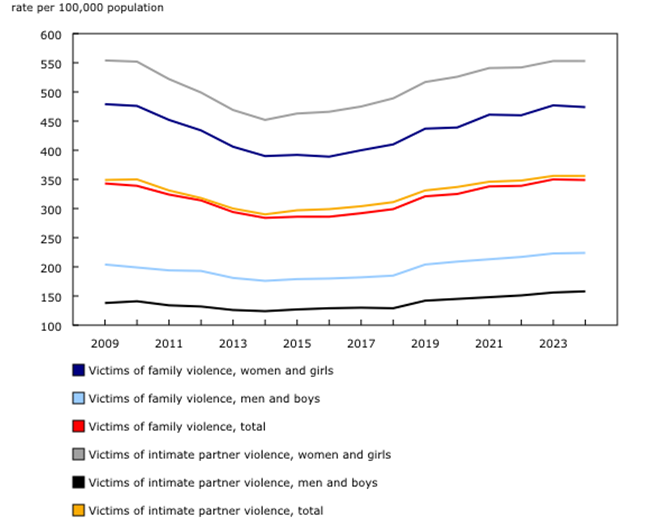
  • In 2024, there were 142,724 victims of family violence and 128,175 victims of intimate partner violence. After many years of gradual increases since the mid 2010s, rates of family violence and intimate partner violence were relatively unchanged in 2024, compared to 2023.
  • The data also highlights that women and girls are largely overrepresented among victims of both family violence and intimate-partner violence, with rates over 2 to 3 times higher than those of men and boys, in 2024.
  • When we look at homicide, we see that the number of women victims of homicide increased in 2024 (+28 victims), in part due to a sharp increase in women victims of intimate partner homicide (from 53 in 2023 to 81 in 2024).
  • These data underscore the need for continued action to address gender-based violence in Canada.
If pressed for specific statistics:
What is the prevalence of family violence and intimate-partner Violence in Canada?Footnote 1
  • In 2024, there were 142,724 victims of family violence and 128,175 victims of intimate partner violence. This represents a rate of 349 victims of family violence per 100,000 population, and 356 victims of intimate partner violence per 100,000 population aged 12 and older.
  • Women and girls are largely overrepresented among victims of both family violence and intimate-partner violence.
    • In 2024, the rate of family violence among women and girls was 2.1 times higher compared to men and boys (474 versus 224 victims per 100,000 population) and the rate of intimate-partner violence was 3.5 times higher (553 versus 158 victims per 100,000 population aged 12+).
  • After many years of consecutive gradual increases since the mid 2010s (see Figure 1), rates of family violence were relatively unchanged in 2024, compared to 2023.
    • In 2024, there were 349 victims of family violence per 100,000 population (compared to 350 in 2023) and 356 victims of intimate partner violence per 100,000 population (unchanged from 2023, 356).
Figure 1: Victims of police-reported family violence and intimate partner violence, by type of violence, gender and year across Canada, 2009 to 2024
Victims of police-reported family violence and intimate partner violence, by type of violence, gender and year across Canada, 2009 to 2024
Figure 1: Image description

This graph shows four trend lines: family violence against women, family violence against men, intimate partner violence against women, and intimate partner violence against men. The x-axis lists each year from 2009 to 2024, and the y-axis shows victimization rates from low to high. Intimate partner violence against women is consistently the highest line across all years. Family violence against women stays at a moderate level, always above the rates for men. Intimate partner violence against men remains lower and relatively steady. Family violence against men is the lowest category, with minimal change over time.

What is the prevalence of family violence among children and youth?Footnote 1
  • The majority of child and youth victims of police-reported family violence are female.
    • In 2024, there were 25,938 child and youth victims of police-reported family violence in 2024, a rate of 345 victims per 100,000 population aged 17 and younger; the majority (60%) of youth victims of family violence were female, and the rate of victimization by family violence was 1.6 times higher for female youth (428 per 100,000 population) than male youth (266 per 100,000 population).
What is the prevalence of firearms in incidents of intimate partner violence?Footnote 1
  • Women and girls victims of intimate partner violence are more likely to be involved in an incident where a firearm was present.
    • In 2024, 16% of victims of intimate partner violence were involved in incidents where a weapon was present. Overall, for 1% of victims, a firearm was present. The presence of a weapon was more common for men and boy victims (25%, versus 14% of women and girl victims), but a firearm was more common for women and girl victims (1.3%, versus 0.8% of men and boy victims).
What is the prevalence of homicide among women in Canada?Footnote 2 Footnote 3
  • The number of women victims of homicide has increased in 2024, in part due to a sharp increase in women victims of intimate partner homicide.
    • In 2024, police reported 788 homicides, 8 fewer than a year earlier. However, there were 28 more women homicide victims in 2024 than in 2023, while there were 34 fewer men.
    • More specifically, the number of women who were killed by a spouse or an intimate partner saw a sharp increase—from 53 in 2023 to 81 in 2024 —while the number of men who were victims remained consistent.
  • Women and girls are overrepresented among victims of family homicide and intimate partner homicide.
    • Between 2014 and 2024, there have been 1,755 victims of family homicide, nearly 6 in 10 (59%) of whom were women and girls.
    • Among the 963 victims of intimate partner homicide between 2014 and 2024, nearly 8 in 10 (79%) were women and girls.
How does the prevalence of gender-based homicide vary across Canada?Footnote 4
  • Higher rates of gender-related homicide of women and girls were found in the territories and in the prairies, as well as in rural areas compared to urban areas.
    • In 2021, the territories recorded the highest rate of gender-related homicide of women and girls (3.20 per 100,000 women and girls) and, for the provinces, the highest rate was in Saskatchewan (1.03), followed by Manitoba (0.72) and Alberta (0.68).
    • In 2021, the rate of gender-related homicide in Canada was more than 2.5 times greater in rural areas compared to urban areas (1.13 versus 0.44 per 100,000 women and girls).
Are certain groups of women more impacted by gender-based violence?
  • Certain groups of women, including women with disabilities, LGB+ women; Indigenous women, and women living in poverty, are more likely to experience intimate partner violence.
    • A 2018 Survey found that rates of intimate partner violence are higher for women with disabilities (55%), LGB+ women (67%); Indigenous women (61%); and women living in poverty (57%) than for all women (44%).Footnote 5 Footnote 6 Footnote 7
  • Indigenous women and girls are overrepresented among victims of female gender-related homicides.
    • A study looked at gender-related homicidesFootnote 8 of women and girls between 2011 and 2021 and found that of all gender-related homicides of women and girls (1,125), 21% (n=233) of victims were Indigenous, despite comprising only 5% of the female population in Canada in 2021.Footnote 4
Q3 - What is Public Safety doing to protect victims of IPV
  • There is no place in Canada for intimate partner violence or gender-based violence. Public Safety, with its partners, is taking action to combat these heinous crimes.
  • This includes working with Women and Gender Equality Canada to advance the Federal Gender-Based Violence Strategy, and the National Strategy on Countering Radicalization to Violence.
  • The Government of Canada is continuing to implement strong legislation so that individuals who pose a danger to others do not have access to firearms, including in situations of intimate partner and family violence.
  • Further, the Government has proposed changes in Bill C-16, also known as the Protecting Victims Act, which would make individuals ineligible for a firearms licence if a chief firearms officer suspects the person may have engaged in domestic violence or stalking.
  • Public Safety also funds projects that prevent cyberbullying, violent extremism, and violent misogyny.
  • The Royal Canadian Mounted Police (RCMP) is addressing gender-based violence and intimate partner violence by equipping its members with education and training, and by strengthening internal policies. In addition, the RCMP participates in provincial Clare's Laws, which provide information about potentially harmful intimate partners.
  • Public Safety Canada is committed to supporting victims and working with partners to end intimate partner violence and gender-based violence in Canada.
Q4 - Does Correctional Services Canada (CSC) offer offenders Intimate Partner Violence (IPV) programming
  • The Government of Canada recognizes that intimate partner violence has far ranging immediate and long-term consequences for victims, their families, and for communities, as it has been linked to the perpetuation of a cycle of intergenerational violence, leading to additional trauma.
  • The Government of Canada recognizes that intimate partner violence has far ranging immediate and long-term consequences for victims, their families, and for communities, as it has been linked to the perpetuation of a cycle of intergenerational violence, leading to additional trauma.
  • In the case of family violence, the goal of correctional programs is to reduce the likelihood of future violence against intimate partners and family members. Offenders who have a need in this area work on developing the skills required to establish and maintain healthy intimate relationships and overcome thinking that justified partner violence and aggression.
  • When looking at all correctional program streams combined, men who completed programming had lower rates of any revocation during their first release than eligible non-participants.
If Pressed – How does CSC assess the risk of intimate partner violence
  • When an offender reaches an institution, they undergo a comprehensive evaluation to determine the factors that may have led to the criminal behaviour for which they have been sentenced.
  • The offender intake assessment process results in a multidisciplinary correctional plan for treatment and intervention throughout the sentence.
  • The family violence risk assessment evaluates the level of risk an offender presents to his partner and is used in correctional planning on all male offenders, prior to the completion of the Correctional Plan.
  • The assessment is further updated upon receipt of additional relevant information.
Q5 - How does CSC manage sexual offenders
  • Although sex offenders represent a small proportion of federal offenders, we know the lasting impact that these offences have on victims and their communities.
  • That is why sexual offenders receive a variety of specific interventions and services while incarcerated, which are matched to their individual levels of risk and need.
  • Evaluations continue to demonstrate the effectiveness of CSC's correctional programs in reducing recidivism, including sex offender programs.
  • Should any change in the offender's behaviour or situation occur which might be linked to an elevated risk to reoffend, CSC takes immediate action to assess its potential so that appropriate steps can be taken to manage the risk to the public.
Q6 - How does CSC supervise offenders in the community
  • All offenders on conditional release are supervised whether they live in the city or in remote parts of the country and the degree of supervision depends on the individual.
  • Offenders who are considered to be at high risk will require closer monitoring.
  • Staff rely on multiple information sources, such as police, family members and program staff, to monitor offenders.
  • CSC staff will not hesitate to take action should an offender disregard conditions or rules.

Firearms control and risk reduction

QP Notes

Q1 - What actions is the Government taking to reduce access to firearms in situations of gender-based violence, including intimate partner violence
  • The Government of Canada has implemented strong legislation so that individuals who may pose a danger to others do not have access to firearms, including in situations of intimate partner and family violence.
  • Since 2022, background checks for a firearms licence include a review of an applicant's entire life history, rather than just the previous five years.
  • "Red Flag" laws have been in place since December 2023 to help protect those in situations when someone's access to a firearm poses a safety risk to the licence holder or an other person, including situations involving intimate partner violence, domestic violence, gender-based violence, and people at risk of suicide.
  • Last November, we announced over $3.7 million in funding to support organizations across Canada on projects to raise awareness of "red flag" laws.
  • As of April 4, 2025, individuals convicted of an offence where violence was used, threatened or attempted against an intimate partners or family member are ineligible for a firearms licence. Chief firearms officers (CFO) must refuse to issue a licence to individuals in these circumstances.
  • Also as of April 4, 2025, chief firearms officers must revoke a licence if they suspect that an individual may have engaged in an act of domestic violence and stalking.
  • Work is actively underway to implement the remaining harm reduction measures, which would prevent an individual who is subject to a protection order from having a firearms licence.
  • This requires that regulations be finalized. Draft regulations were published in March 2025, and work is actively underway to address feedback from victims, such as the inclusion of peace bonds. We have committed to bring them forward in Spring 2026.
  • To further strengthen licensing, the Government recently proposed changes to the Firearms Act in Bill C-16, also known as the Protecting Victims Act, which would make individuals ineligible for a firearms licence if a chief firearms officer suspects the person may have engaged in domestic violence or stalking.
  • These measures complement existing protective tools and will help to reduce the risks associated with intimate-partner and gender-based violence involving firearms.
Q2 - What measures are in place to ensure that an individual is eligible to hold a firearms licence
  • When determining whether an applicant is eligible for a firearms licence, chief firearms officers must consider a number of eligibility criteria, including things like past convictions of violent and other offences, previous prohibition orders, and other safety risks.
  • Since 2022, these background checks were expanded to include an applicant's entire life history when determining eligibility rather than just the previous five years.
  • Individuals must also complete a safety course to be eligible for a firearms licence and provide references when applying for a licence.
  • After a firearms licence is issued, continuous eligibility screening is conducted over the term of the licence. Information that is brought to the attention of a chief firearms officer may raise concerns and require the review of the licence holder's eligibility to continue to hold the firearms licence.
  • The new licence suspension regime, also known as "yellow flag" laws, has been in effect since March 7, 2025. This requires a chief firearms officer to suspend a firearms licence when they have reasonable grounds to suspect that a licence holder is not eligible to hold it. This prevents the individual from acquiring, transferring or importing firearms for up to 30 days.
Q3 - How can Canadians bring forward concerns about an individual's eligibility to hold a firearms licence or whether they pose a public safety risk
  • In urgent or life-threatening situations, individuals should always call 911 or their local police emergency number.
  • In non-urgent situations with safety risks, individuals should also consider calling 911 or their local police emergency number. They can also apply to a provincial or territorial court for an emergency prohibition order or an emergency limitations on access order, also known as "red flag" laws.
  • If a granted by a court, possession of firearms will be prohibited for up to 30 days and any firearm or other weapon in their possession will be removed.
  • In other non-urgent situations where there may not be immediate safety risks to the security of a person, any member of the public can report firearm-related concerns, including concerns about storage, transportation and use, by contacting the Royal Canadian Mounted Police's Canadian Firearms Program via existing toll-free telephone number for contacting chief firearms officers.
Q4 - Is the rate of firearms-related intimate partner violence (IPV) in Canada rising or declining
  • The rate of firearms-related IPV in Canada has been rising over the past 15 years.
  • In 2023, a firearm was present for 1% of victims of police-reported IPV; that is, 1,699 victims with 84% (1,051) of these victims being women and girls.
  • While women and girls accounted for nearly one in four (23%) victims of solved shooting homicides in 2023, they accounted for half (50% or 15 of 30) of victims of shooting homicides perpetrated by a family member or an intimate partner.
  • This is a decline from 2022 (64%), 2018 (68%). and 2013 (62%),when women and girls represented more than six in ten victims of solved shooting homicides perpetrated by a family member or an intimate partner.
Q5 - How do the "red flag" laws work? How can they be used to help address intimate partner and domestic violence
  • "Red Flag" laws allow any individual to apply to a court for an emergency prohibition or limitations on access order, to prohibit temporarily possession or access to firearms or another weapon by an individual who may pose risks to themselves or others.
  • These orders complement existing tools, such as calling 911 in urgent and life-threatening situations.
  • When an emergency prohibition order is issued, the person cannot possess a firearm or any other weapon for up to 30 days. Any firearm, firearm licence, other ownership documents, or other weapons in their possession must be surrendered. The weapons may be seized by police or turned in by the owner.
  • The court can also set a hearing date to consider a longer-term prohibition order which can last up to five years.
  • An emergency limitation on access order set rules for another person's possession or use of firearms if there is a risk that their firearms could be accessed by someone who is already under a prohibition order.
  • These orders do not result in a criminal record for the person subject to the order, except in the event of a breach of the order and conviction of an offence.
  • If an emergency prohibition order expires, the person's firearms licence and any other ownership documents, firearms and other items will be returned to the owner.
Q6 - Do the "red flag" laws require that survivors or victims of violence, including IPV, go to court on their own to have firearms removed from someone who is a risk to them or others
  • "Red flag" laws do not require survivors or victims of violence to go to court on their own or make an application. Anyone can apply for an emergency prohibition or emergency limitations on access order.
  • Friends, family, neighbours, social services staff, or any other concerned person can apply for either of these order if they believe an individual poses a safety risk to themselves or others.
Q7 - What do the "red flag" laws mean for sustenance hunters
  • There may be cases where a person subject to an emergency prohibition order needs a firearm(s) to hunt or trap to sustain themselves or their family.
  • In these situations, the individual can ask the court to lift the emergency prohibition order so they can continue to use their firearm(s) for those purposes.
  • In making its decision, the court must take into account a number of considerations, including criminal record of the person, if any, the nature and circumstances of the situation that led to the emergency prohibition order, and the safety of the person or of other persons.
  • If the emergency prohibition order is lifted, the chief firearms officer is authorized to issue a firearms licence if there are no other eligibility concerns. Both the court and/or chief firearms officer may add restrictions for the person's continued use of firearms.
Q8 - How do the "yellow flag" laws work
  • "Yellow flag" laws took effect on March 7, 2025, creating a temporary firearms licence suspension regime.
  • If a chief firearms officer has reasonable grounds to suspect that a licence holder is no longer eligible for a firearms licence, they must suspend the licence for up to 30 days.
  • During the suspension, the licence holder will be allowed to keep their firearm(s) but will not be allowed to use, acquire, or import firearms.
  • If the licence holder does not follow these restrictions, their licence can be revoked.
  • The licence holder's use, acquisition and import privileges will be reinstated once the suspension period has elapsed or earlier if the chief firearms officer is satisfied that the reasons for suspension no longer exist.
  • If a chief firearms officer determines that a licence holder is ineligible for a licence, they may revoke the firearms licence at any time.
Q9 - How do "yellow flag" laws improve early intervention and risk reduction in domestic violence cases
  • The "yellow flag" laws relate to eligibility and enhance the ongoing screening of firearms licences.
  • Prior to the introduction of the licence suspension regime, if a chief firearms officer suspected a licence holder was ineligible for a firearms licence but had not yet decided whether to revoke the licence, the licence holder maintained all authorizations associated with the licence until a decision was made to revoke.
  • The new regime provides an opportunity for the CFO to investigate and determine whether the licence holder should have their firearms licence reinstated or revoked, while preventing the licence holder from using, acquiring, or importing firearms during this time.
  • As the licence holder remains in possession of their firearms during the suspension, the "yellow flag" laws are not designed to intervene in at risk situations. There are other more appropriate mechanisms.
Q10 - How do the new licence ineligibility and revocation measures help address domestic and intimate partner violence
  • While many firearms are used safely and lawfully, firearms violence and associated risks in situations of intimate partner and family violence continues to be a persistent problem.
  • The new measures focus on these at-risk situations and aim to remove the means to access firearms to help better ensure the safety of those involved.
Q11 - Under what circumstances can a firearms licence be refused
  • The Firearms Act provides chief firearms officers with criteria that must be considered in determining eligibility and a person's ongoing eligibility to hold a licence.
  • These include, among other things: whether the person has been treated for a mental illness associated with violence, has a history of violent behaviour, or has been convicted of certain Criminal Code offences.
  • A chief firearms officer must refuse to issue a licence if the applicant is not eligible to hold one.
  • Under the new measures, an individual is automatically ineligible to hold a firearms licence when they are subject to a protection or have been convicted of an offence where they used, threatened or attempted violence against an intimate partner or family member.
Q12 - Under what circumstances can a firearms licence be revoked
  • Under the Firearms Act, in most cases, chief firearms officers have discretion to revoke a firearms licence for any sufficient and good reason.
  • In some cases, however, a licence must be revoked as a matter of law. This includes if an individual is subject to a prohibition order issued by a court and reported to the chief firearms officer.
  • A chief firearms officer must now also revoke a firearms licence if they have reasonable grounds to suspect that an individual has engaged in domestic violence or stalking.
  • Once regulations are in place, a licence will also have to be revoked if an individual is subject to protection order issued by a competent authority and reported to the chief firearms officer.
Q13 - What do the expanded licence revocation authorities mean for sustenance hunters
  • In these circumstances, a chief firearms officer has authority to issue a conditional licence to an individual if they are satisfied the individual requires a firearm(s) to hunt or trap to sustain themselves or their family.
  • The proposed Regulations outline a non-exhaustive list of factors that chief firearms officers would have to consider prior to issuing a licence, including whether the primary, but not sole, source of food or income for the applicant or their family is through hunting or trapping or the nature and circumstances in respect of why the refusal or revocation of the licence of the applicant was issued, if known.
  • Individuals would need to apply for this licence and provide a statement with reasons explaining why they require the firearm for hunting or trapping to sustain themselves or their family.
  • The application would only be for non-restricted firearms which are the firearms authorized for use in hunting activities across Canada.
Q14 - How will these new measures improve safety outcomes for individuals in at-risk situations, including those experiencing IPV
  • Access to firearms is not a right in Canada; rather it is a privilege as the possession of firearms is permitted for authorized purposes subject to public safety considerations.
  • The new "red flag" laws and mandatory ineligibility and revocation measures will improve safety outcomes by ensuring the loss of firearms privileges in at-risk situations, including intimate partner violence.
Q15 - What new measures are being put in place to address firearm safety risks posed by individuals subject to a protection order
  • Once regulations are made, individuals subject to a protection order will not have access to a firearms licence – an application will be refused and a licence will be revoked.
Q16 - Why is it taking the Government so long to bring these new measures into force
  • Consultations were required to develop the regulations and to ensure readiness and effective implementation of these harm reduction measures related to protection orders.
  • These new measures received Royal Assent in December 2023 and proposed regulations were published in March 2025.
  • Following public and stakeholder feedback on the proposed regulations, work is actively underway to address feedback from victims, such as the inclusion of peace bonds in the definition of "protection order" and to bring the regulations forward in Spring 2026.
Q17 - If an individual subject to a peace bond poses a risk to themselves or others, how can we ensure they do not have access to firearms
  • In 2024, 2,339 licences were revoked and 374 licence applications were refused due to the individual being subject to a court ordered prohibition order or probation order.
  • This would include peace bonds issued with firearms prohibitions as a condition.
  • We can ensure courts are aware of their reporting obligations under the Firearms Act when they issue peace bonds and any other order under the Criminal Code with conditions that prohibit the individual from possessing firearms.
  • Further, acknowledging feedback received during the pre-publication of proposed regulations to support full implementation of new mandatory ineligibility and revocation measures, Public Safety is exploring ways to strengthen the definition of "protection order", such as the inclusion of peace bonds.

Protection Orders and Peace Bonds (Criminal Code s.810)

QP Notes

Q1 - What are protection orders
  • Generally, protection orders are binding orders to help protect someone's safety and security, mainly in situations of intimate partner or family violence or where there is harassing or threatening conduct.
  • They go by various names, such as restraining orders, emergency intervention orders, have varying lengths and can have conditions attached to them that prevent a person from engaging in certain behaviours, such as not communicating with a specified person, or being in a specified place or being in possession of a firearm.
Q2 - How are protection orders treated in the firearms regime
  • For the purpose of firearms licensing, protection order will be defined in regulation.
  • Under the Firearms Act, the issuance of a protection order – as defined in regulation – will make an individual ineligible to hold a firearms licence. This means their licence application will be refused or licence will be revoked.
  • They will remain ineligible to hold a licence until the protection order is either revoked or expires.
Q3 - What measures are in force
  • New "red flag" laws have been in place since December 2023, allowing anyone to apply to the court if they believe a licence holder poses a risk to themselves or others. If the court agrees, this would result in the temporary removal of access to firearms.
  • As of April 4, 2025, an individual is ineligible for a licence if they are convicted of an offence involving violence against an intimate partner or family member. This means a chief firearms officer must refuse to issue a licence to individuals in these circumstances.
  • Likewise, as of April 4, 2025, a chief firearms officer must revoke a licence if they have reasonable grounds to suspect that an individual has engaged in an act of domestic violence and stalking.
  • In these circumstances, a chief firearms officer may issue a conditional licence to an individual if they require a firearm to hunt or trap to sustain themselves or their family.
  • Mandatory licence refusal or revocation for individuals subject to a protection order will only be fully operable when the regulation defining "protection order" are finalized and reporting requirements are brought into force.
  • We have committed to bring these regulations forward in Spring 2026.
Q4 - Does the Parole Board of Canada (PBC) consider peace bonds when making parole decisions or assessing risk
  • Parole Board of Canada Board members must legally consider all relevant available information when making conditional release decisions.
  • Board members assess risk by reviewing all relevant aspects of the case, including withdrawn/stayed/acquitted information and peace bonds, and ensuring that the information upon which they base their decision is reliable and persuasive.
  • Sources of information in Board decision-making include victim statements, police reports, court and sentencing records, reports from correctional authorities, mental health assessments, and actuarial and risk assessment tools.
Q5 - How does PBC receive information about peace bonds from courts or law enforcement
  • As criminal justice partners, the Parole Board of Canada (PBC) and the Correctional Service of Canada (CSC) work together closely, which includes the sharing of timely, comprehensive and accurate information on offenders.
  • CSC provides the PBC with risk relevant information, including court information and police reports.
  • In all cases, if Board members determine relevant information is missing or incomplete, they will request that correctional authorities provide the information before they render a decision.
Q6 - What is the current data on Intimate Partner and Gender-Based Violence
  • Statistics Canada releases data annually on the prevalence of key forms of gender-based violence, including family violence, intimate partner violence and homicide.
  • In 2024, there were 142,724 victims of family violence and 128,175 victims of intimate partner violence. After many years of gradual increases since the mid 2010s, rates of family violence and intimate partner violence were relatively unchanged in 2024, compared to 2023.
  • The data also highlights that women and girls are largely overrepresented among victims of both family violence and intimate-partner violence, with rates over 2 to 3 times higher than those of men and boys, in 2024.
  • When we look at homicide, we see that the number of women victims of homicide increased in 2024 (+28 victims), in part due to a sharp increase in women victims of intimate partner homicide (from 53 in 2023 to 81 in 2024).
  • These data underscore the need for continued action to address gender-based violence in Canada.
If pressed for specific statistics:
What is the prevalence of family violence and intimate-partner Violence in Canada?Footnote 1
  • In 2024, there were 142,724 victims of family violence and 128,175 victims of intimate partner violence.
  • This represents a rate of 349 victims of family violence per 100,000 population, and 356 victims of intimate partner violence per 100,000 population aged 12 and older.
  • Women and girls are largely overrepresented among victims of both family violence and intimate-partner violence.
    • In 2024, the rate of family violence among women and girls was 2.1 times higher compared to men and boys (474 versus 224 victims per 100,000 population) and the rate of intimate-partner violence was 3.5 times higher (553 versus 158 victims per 100,000 population aged 12+).
  • After many years of consecutive gradual increases since the mid 2010s (see Figure 2), rates of family violence were relatively unchanged in 2024, compared to 2023.
    • In 2024, there were 349 victims of family violence per 100,000 population (compared to 350 in 2023) and 356 victims of intimate partner violence per 100,000 population (unchanged from 2023, 356).
Figure 2: Victims of police-reported family violence and intimate partner violence, by type of violence, gender and year across Canada, 2009 to 2024
Victims of police-reported family violence and intimate partner violence, by type of violence, gender and year across Canada, 2009 to 2024
Figure 2: Image description

This graph shows four trend lines: family violence against women, family violence against men, intimate partner violence against women, and intimate partner violence against men. The x-axis lists each year from 2009 to 2024, and the y-axis shows victimization rates from low to high. Intimate partner violence against women is consistently the highest line across all years. Family violence against women stays at a moderate level, always above the rates for men. Intimate partner violence against men remains lower and relatively steady. Family violence against men is the lowest category, with minimal change over time.

What is the prevalence of family violence among children and youth?Footnote 1
  • The majority of child and youth victims of police-reported family violence are female.
    • In 2024, there were 25,938 child and youth victims of police-reported family violence in 2024, a rate of 345 victims per 100,000 population aged 17 and younger; the majority (60%) of youth victims of family violence were female, and the rate of victimization by family violence was 1.6 times higher for female youth (428 per 100,000 population) than male youth (266 per 100,000 population).
What is the prevalence of firearms in incidents of intimate partner violence?Footnote 1
  • Women and girls victims of intimate partner violence are more likely to be involved in an incident where a firearm was present.
    • In 2024, 16% of victims of intimate partner violence were involved in incidents where a weapon was present. Overall, for 1% of victims, a firearm was present. The presence of a weapon was more common for men and boy victims (25%, versus 14% of women and girl victims), but a firearm was more common for women and girl victims (1.3%, versus 0.8% of men and boy victims).
What is the prevalence of homicide among women in Canada?Footnote 2 Footnote 3
  • The number of women victims of homicide has increased in 2024, in part due to a sharp increase in women victims of intimate partner homicide.
    • In 2024, police reported 788 homicides, 8 fewer than a year earlier. However, there were 28 more women homicide victims in 2024 than in 2023, while there were 34 fewer men.
    • More specifically, the number of women who were killed by a spouse or an intimate partner saw a sharp increase—from 53 in 2023 to 81 in 2024 —while the number of men who were victims remained consistent.
  • Women and girls are overrepresented among victims of family homicide and intimate partner homicide.
    • Between 2014 and 2024, there have been 1,755 victims of family homicide, nearly 6 in 10 (59%) of whom were women and girls.
    • Among the 963 victims of intimate partner homicide between 2014 and 2024, nearly 8 in 10 (79%) were women and girls.
How does the prevalence of gender-based homicide vary across Canada?Footnote 4
  • Higher rates of gender-related homicide of women and girls were found in the territories and in the prairies, as well as in rural areas compared to urban areas.
    • In 2021, the territories recorded the highest rate of gender-related homicide of women and girls (3.20 per 100,000 women and girls) and, for the provinces, the highest rate was in Saskatchewan (1.03), followed by Manitoba (0.72) and Alberta (0.68).
    • In 2021, the rate of gender-related homicide in Canada was more than 2.5 times greater in rural areas compared to urban areas (1.13 versus 0.44 per 100,000 women and girls).
Are certain groups of women more impacted by gender-based violence?
  • Certain groups of women, including women with disabilities, LGB+ women; Indigenous women, and women living in poverty, are more likely to experience intimate partner violence.
    • A 2018 Survey found that rates of intimate partner violence are higher for women with disabilities (55%), LGB+ women (67%); Indigenous women (61%); and women living in poverty (57%) than for all women (44%).Footnote 5 Footnote 6 Footnote 7
  • Indigenous women and girls are overrepresented among victims of female gender-related homicides.
    • A study looked at gender-related homicidesFootnote 8 of women and girls between 2011 and 2021 and found that of all gender-related homicides of women and girls (1,125), 21% (n=233) of victims were Indigenous, despite comprising only 5% of the female population in Canada in 2021.Footnote 4
Q7 - What is Public Safety doing to protect victims of Intimate Partner Violence
  • When determining whether an applicant is eligible for a firearms licence, chief firearms officers must consider a number of eligibility criteria, including things like past convictions of violent and other offences, previous prohibition orders, and other safety risks.
  • Former Bill C-71 expanded these background checks to include an applicant's entire life history when determining eligibility rather than just the previous five years.
  • After a firearms licence is issued, continuous eligibility screening is conducted over the term of the licence. Information of concern that is brought to the attention of a chief firearms officer may bring an individual's eligibility to hold a licence into question. That individual might then be subject to review.
  • A suite of measures has also been implemented so that individuals who pose a danger to others do not have access to firearms, including in situations of intimate partner and family violence.
  • "Red flag" laws, which are in effect, help victims and individuals to engage the courts to temporarily prohibit anyone that poses a risk to themselves or others from possessing or accessing firearms.
  • Last November, we announced over $3.7 million in funding to support organizations across Canada on projects to raise awareness of "red flag" laws.
  • Effective April 4, 2025, individuals will have their firearms licence revoked where it is suspected that they've been involved in domestic violence or stalking.
  • Also, individuals are automatically ineligible to hold a firearms licence if they have been convicted of an offence in the commission of which violence was used, threatened or attempted against their intimate partner or family member.
  • To further strengthen licensing, the Government recently proposed changes to the Firearms Act in Bill C-16, also known as the Protecting Victims Act, which would make individuals ineligible for a firearms licence if a chief firearms officer suspects the person may have engaged in domestic violence or stalking.
  • Efforts are also underway to fully implement measures that require the refusal or revocation of a firearms licence when an individual is subject to a protection order. This requires that regulations be finalized.
  • Engagement is ongoing to support effective implementation and work is actively underway to address feedback from victims, such as the inclusion of peace bonds, and to bring the regulations forward in Spring 2026.
  • These measures complement existing protective tools and will help to reduce the risks associated with intimate-partner and gender-based violence involving firearms.
Q8 - When an offender moves to a different province or territory, what measures are taken to ensure that the appropriate authorities in their new location are aware of any conditions applicable to the offender or any breaches of those conditions by the offender
  • Both the Correctional Service of Canada (CSC) and the Parole Board of Canada (PBC) maintain jurisdiction over federal offenders – those serving a sentence of two years or more – who are on conditional release and move to a different province or territory.
  • Accordingly, even though a supervising parole office may change with an offender moving from one province to another, their file information, including any special conditions on their release, is readily shared through a national database to parole officers in different communities.
  • The Corrections and Conditional Release Act (CCRA) set outs the circumstances under which offender information is shared with law enforcement by both CSC and the PBC, including information related to conditional release and the expiration of a sentence.
  • Frontline law enforcement has access to specific, relevant information on supervised federal offenders through InfoPol and the Canadian Police Information Centre system, including the offender's release conditions and any warrant issued for their apprehension for breaching these conditions.
  • Importantly, the information on release conditions available to local police officers also allows them to inform CSC immediately should an offender be suspected of a breach. CSC can then take steps to suspend their release, if warranted, which can ultimately be revoked by the PBC, and the offender returned to custody.
  • With respect to provincial offenders, the CCRA provides the PBC with jurisdiction over all provincial offenders - those serving sentences of less than two years – in instances where no provincial parole board has been established. At present, this includes all provinces and territories except Ontario, Quebec and Alberta, each of which has its own parole board.
  • The transfer of a provincial offender to, from or between Ontario, Quebec or Alberta is governed by the Transfer of Parole Jurisdiction Agreement (TPJA). The TPJA ensures that when an offender relocates from one jurisdiction to another, the authority to render subsequent parole decisions and to provide effective community supervision, including monitoring any conditions, will transfer to the jurisdiction in which the offender resides.
  • The TPJA also outlines procedural and logistical elements to facilitate the transfer, including the sharing of specific offender information. Ultimately, this benefits public safety by ensuring seamless supervision by local jurisdictions.
Q9 - What actions has the federal government taken to support cross jurisdictional data sharing between police, Crown, and parole authorities to ensure that when an offender moves to a new province or territory their information follows them
  • As previously noted, structure processes are in place to support information sharing, including when an offender moves provinces or territories.
  • I would highlight an additional recent action taken by the federal government to support cross-jurisdictional information sharing with respect to federal offenders, specifically the introduction of Bill C-16, the Protecting Victims Act.
  • While the primary focus of Bill C-16 is to make important enhancements to the criminal justice system, including to support victims of crime, it also proposes critical amendments to the Corrections and Conditional Release Act (CCRA) with respect to its information sharing provisions.
  • In particular, C-16 proposes amendments to establish a clear and comprehensive framework for the Correctional Service of Canada (CSC) to share information with Canadian law enforcement, domestic prosecutorial bodies, and oversight and investigative bodies regarding current and, in some circumstances, past federal offenders.

Bail and electronic monitoring

QP Notes

Q1 - What challenges exist with electronic bracelet monitoring where the Royal Canadian Mounted Police (RCMP) is the Police of Jurisdiction (POJ)
  • Victim safety relies on active monitoring and rapid police response when GPS alerts indicate non-compliance (e.g., entering exclusion zones such as near a victim's home, or tampering).
  • GPS devices can fail in certain environments, for example, poor satellite coverage in remote regions or urban "canyons" (dense buildings) causing signal loss.
  • There may also be frequent false alerts and battery issues that complicate enforcement. These technical gaps make it more challenging to rely on monitoring as a safety measure alone.
  • The police are notified of a potential breach after the fact. For RCMP detachments that may be operating within resource constraints, especially in rural or remote areas, this could mean that alerts may not be prioritized or acted upon immediately.
  • Rural communities struggle with electronic monitoring suitability primarily due to poor or absent broadband internet and cellular service, unreliable power, geographical isolation limiting rapid response, high infrastructure costs, and inadequate localized support systems (social/economic).
Q2 - How does electronic monitoring work for federal offenders
  • Ensuring the safety and security of our communities is a top priority for Correctional Services Canada (CSC) and electronic monitoring contributes to ensuring the safe transition and management of offenders.
  • CSC may demand that some offenders wear an electronic monitoring device in order to monitor their compliance with certain geographical special conditions.
  • It is a community supervision tool currently available and adopted by parole officers in all regions of the country to monitor higher-risk offenders
  • It is important to note that electronic monitoring is not a stand-alone tool intended to replace traditional means of supervising offenders on conditional release. Rather, it is an additional tool available to community parole officers that can be used with other community supervision measures to help supervise offenders and keep our communities safe.
Q3 - How is the RCMP informed when an individual breeches the conditions of their release
  • GPS devices send alerts for violations such as entering exclusion zones (e.g., near a victim's home), missing curfew, or tampering with the device.
  • These alerts are received by monitoring centres. For federal offenders, this is to Correctional Service of Canada's National Monitoring Centre (NMC). For provincial offenders, alerts are received by provincial monitoring programs, which are often run by private contractors.
  • Alerts are typically sent via direct electronic notification systems, phone calls, or integrated dispatch platforms. In some provinces, alerts go to probation officers first, who then contact the RCMP for enforcement. In urgent cases, monitoring centers notify the RCMP directly for immediate intervention.
  • When an alert is sent to the RCMP, it is most commonly after the fact. Then, if warranted, a follow up criminal investigation is required for bail violation situations.
  • Under R. v. Zora (2020 SCC 14), police must prove intent for breach charges, adding investigative complexity. As such, any GPS notification must be followed up with a thorough criminal investigation securing evidence of "intent" to violate the condition. This means the RCMP cannot simply act on an alert; they need evidence of knowing or reckless non-compliance.
  • The Crown may not proceed with charges for breaches that lack sufficient evidence or fall short of public interest, which leads to unnecessary work for police.
Q4 - What teams are in place to monitor repeat offenders
  • Some RCMP detachments have Crime Reduction Units, whose mandates are to limit the impact of repeat offenders, including those on bail or other release conditions. These units support bail condition compliance through curfew checks and other enforcement, but the volume of offenders who are out on release conditions makes it difficult to ensure compliance and enforce all bail conditions.
  • With repeat violent offenders, they are sometimes re-arrested after or during the commission of another or new offence.
Q5 - What are the complimentary measures on bail and the programs to enhance enforcement and reduce recidivism
  • With respect to bail, Bill C-14, the Bail and Sentencing Reform Act, which was introduced in October 2025 by the federal government, proposes important changes to the Criminal Code. In particular, C-14 creates new reverse onus provisions for some of the most serious cases, requires courts to consider specific factors, including if the allegations involved random or unprovoked violence and if the accused has any outstanding charges, and set stricter conditions, including weapons bans.
  • Although responsibility for C-14 and the bail provisions of the Criminal Code lies with our federal justice colleagues, Public Safety Canada has an important, supportive role to play in providing funding and programs to provinces, territories, and municipalities for broader public safety objectives, including on efforts to enhance Canada's bail system.
  • In particular, Public Safety Canada continues to explore opportunities to support non-legislative bail reform efforts through funding and programs to ensure that tools and resources are in place, including investments to enhance bail enforcement, combat the criminal use of firearms, and prevent gang violence and crime. This includes the National Crime Prevention Strategy and the Building Safer Communities Fund.
  • The Federal Framework to Reduce Recidivism (FFRR) is another way the government is improving community safety. The 2025 Progress Report on the FFRR, published in October 2025, highlights the initiatives underway across its five priority areas: housing, employment, education, health and positive support networks, and emphasizes progress made in aligning federal efforts to support individuals exiting the federal correctional system. These initiatives help to support community reintegration, to help reduce reoffending and victimization.
  • At the same time, provinces, territories, and municipalities remain critical partners in ensuring that these reforms strengthen the administration of justice and enhance public trust. Law enforcement, the courts, and corrections play a central role in this regard, specifically in investigating and prosecuting most Criminal Code offences, conducting bail hearings, enforcing bail conditions including breaches, and operating most custodial facilities where individuals are held awaiting trial.
Q6 - How does the Parole Board of Canada receive information about peace bonds from courts or law enforcement
  • As criminal justice partners, the Parole Board of Canada (PBC) and the Correctional Service of Canada (CSC) work together closely, which includes the sharing of timely, comprehensive and accurate information on offenders.
  • CSC provides the PBC with risk relevant information, including court information and police reports.
  • In all cases, if Board members determine relevant information is missing or incomplete, they will request that correctional authorities provide the information before they render a decision.

Victim safety and participation

QP Notes

Q1 - What victim services are available when the Royal Canadian Mounted Police (RCMP) are police of jurisdictions
  • Victim services vary by province and territory and are publicly available on Canada.ca under the Office of the Federal Ombudsperson for Victims of Crime. These services include:
    • victim services webpages cultivated by provinces and territories;
    • legal aid and legal services;
    • provincial and territorial ombudspersons,
    • financial benefits and compensation programs; and
    • Provincial/Territorial Parole Board webpages.
  • At the time of an incident, RCMP officers advise victims of their rights under the Canadian Victims Bill of Rights (CVBR), and provide referrals to victim services programs who, in turn:
    • lessen the impact of crime and trauma on victims and their families and assist them in their recovery;
    • enhance victim safety and help reduce the risk of further victimization;
    • increase victims' level of participation in the criminal justice system; and
    • Prepare victims who are acting as witnesses for court proceedings.
  • The RCMP has developed a national CVBR wallet card that outlines the victims' rights to information, protection, participation and to seek restitution under the CVBR; lists information about victim services; and leaves space for officer and other contact information that can be customized, as needed.
  • Recently introduced, Bill C-16, the Protecting Victims Act, would amend the CBVR to introduce new rights to respect and timely access to justice, and improve victims' rights to information and protection.
Q2 - What trauma-informed training do RCMP officers undertake
  • As part of the Government of Canada's Strategy to Prevent and Address Gender-Based Violence, the RCMP developed two courses for RCMP employees aimed at educating trainees on how to use a trauma-informed approach when conducting investigations, as well as helping employees better understand the impacts of culture and personal identity on actions, perceptions, interactions and experiences. The Cultural Awareness and Humility and Using a Trauma-Informed Approach courses are mandatory for all RCMP police officers and, in the case of the latter, all staff who serve the public. Both courses are also available to other law enforcement agencies via the Canadian Police Knowledge Network.
  • There are also several trauma-informed courses and guides available to RCMP personnel via the RCMP's internal training platform, the Canadian Police Knowledge Network, the Canadian Police College and the Pacific Region Training Centre.
  • Examples include:
    • Violence/Abuse in Relationships Investigational Aids - Resource Guide;
    • Integrated Approaches to Interpersonal Violence and Abuse; and
    • Sexual Offence Investigation Workshop.
Q3 - What role do victims have in parole hearings and how are their statements considered? (include stats on victim participation)
  • Victims can register with the Parole Board of Canada (PBC) to receive information and to provide a Victim Statement describing the ongoing impact of the crime and any safety concerns.
  • Registered victims can provide a Victim Statement to the Board at any time during an offender's sentence for consideration in a conditional release decision (i.e., parole).
  • When a Victim Statement has been provided to the Board, conditions that are considered reasonable and necessary to protect victims may be imposed on an offender's release.
  • When victims request conditions for their protection and Board members decide not to impose any conditions, written reasons must be provided.
  • If conditions have been requested by the victim and imposed by the Board, before removing or varying any of these conditions, the Board must take reasonable steps to inform the victim.
  • Victims' personal information (address, phone, email or other contact information) is not shared with the offender, only the statement content is shared as required to comply with the legal principle of procedural fairness.
  • Victims can request to observe a hearing, present their statement at a hearing, request to listen to the audio recording of a parole hearing, and request written decisions from the PBC's Registry of Decision.
  • Victims are supported by regional communication officers, who also attend hearings with victims to explain the process and answer any questions they may have.
  • In 2024-25, the Board had more than 24,000 contacts with victims. Victims presented almost 400 statements at a parole hearing and received over 3,400 parole decisions from the Parole Board's Decision Registry.
Q4 - If a victim moves to another province for safety, how is their information protected while still sharing conditions with law enforcement
  • At the federal level, Correctional Service Canada (CSC) and the Parole Board of Canada protect victim information, and do not disclose victims' personal contact details to offenders under any circumstances.
  • Victims can communicate safety concerns directly to Correctional Service Canada or the Parole Board of Canada for consideration in corrections and parole decisions. These concerns may be submitted at any time.
  • The Parole Board of Canada must consider victim-identified safety concerns and may impose reasonable and necessary release conditions, such as non-contact orders or geographic restrictions, to help mitigate risk.
Q5 - What safeguards exist to prevent an offender from accessing a victim's new address through court or police records

Protecting victims' personal information, while providing them with information, is central to meeting the needs of victims of crime. Former Public Senate Bill S-12 introduced new provisions confirming victims' interest in receiving post-sentence information and requiring courts to share victim contact information with CSC for this purpose. Protecting victim contact information is a priority in establishing secure systems between courts and CSC.

Training and professional capacity

QP Notes

Q1 - How does Correctional Services Canada (CSC) supervise offenders in the community
  • All offenders on conditional release are supervised whether they live in the city or in remote parts of the country and the degree of supervision depends on the individual.
  • Offenders who are considered to be high risk will require closer monitoring.
  • Staff rely on multiple information sources, such as police, family members and program staff, to monitor offenders.
  • CSC staff will not hesitate to take action should an offender disregard conditions or rules.
Q2 - What training do Parole Board of Canda (PBC) Board members receive to prepare them to consider issues of gender-based violence, intimate partner violence, and feminicide in their decision-making
  • All Parole Board of Canada (PBC) Board members receive mandatory orientation and continuous training on gender-based violence, intimate partner violence (IPV), and related issues.
  • The training integrates evidence-based practices, cultural awareness, and victim-centered approaches.
  • The training supports Board members in identifying and assessing risk factors associated with IPV and femicide, and imposing risk mitigating measures to manage risk relevant IPV factors, while prioritizing public safety and respecting the rights and dignity of all participants.
  • The PBC recognizes that cases involving gender-based violence, IPV, and femicide require a heightened level of sensitivity, expertise, and rigor in decision-making.
  • Gender-based violence, IPV, and femicide and the risk relevant power dynamics associated with these issues can have profound impacts on victims, families, communities, and parole candidates, and the Board is committed to ensuring that its members are fully equipped to identify and address them.
Board Member Orientation
  • Upon appointment, Board members participate in an intensive orientation program that includes a module on violent offenders, which addresses the dynamics of gender-based violence and IPV in both male and female populations.
  • They also participate in regional training on IPV to provide them with a deeper understanding of domestic violence and risk assessment, which includes learning about various IPV risk actuarial tools.
Continuous Training
  • Board members participate in mandatory continuous training through annual forums, specialized sessions, and targeted communiqués to remain current on emerging research and best practices.
  • Recent specialized sessions have included trauma-informed approaches (2023) and dedicated IPV risk assessment training (2024).
  • The PBC provides Board members with access to a repository of IPV-related research, guidelines, and training materials, ensuring continuous access to current information and best practices to support informed decision-making.
Gender-Responsive and Cultural Awareness Training
  • The PBC provides Board members with gender-responsive and cultural awareness training opportunities.
  • These training initiatives emphasize systemic and background factors such as racism, poverty, and family breakdown, which intersect with IPV and femicide risk.
  • Mandatory Indigenous Cultural Responsiveness Training includes discussions on intergenerational trauma, family violence, and culturally appropriate reintegration strategies.
Q3 - What training do PBC Board members receive on trauma-informed approaches in decision-making, and what are its main objectives
  • The PBC provides Board members with comprehensive training that embeds trauma-informed principles into its culture and decision-making frameworks.
  • Trauma-informed decision-making is essential to ensuring fairness, respect, and sensitivity in the conditional release process.
  • The PBC is committed to trauma informed hearings, recognizes that trauma can profoundly affect victims, families, communities and parole candidates, influencing participation in hearings, behaviour, and reintegration outcomes.
  • This approach helps reduce the risk of re-traumatization, promotes respectful engagement, and supports rehabilitation while maintaining public safety.
  • Training covers how trauma affects participation in hearings and reintegration, victimization in marginalized groups (including Black and Indigenous communities and women), intergenerational and historical trauma, risk assessment in family and IPV cases, and strategies for engaging victims and offenders in a trauma-informed way.
  • The core objectives of these training activities aim to equip Board members to make fair and legally sound decisions that are sensitive to trauma, engage respectfully with victims and other participants, minimize the risk of re-traumatization during hearings, and apply culturally responsive practices that support rehabilitation and public safety.
Board Member Orientation

Trauma-informed principles are introduced to Board members during orientation, emphasizing safe, respectful and culturally responsive communication, and promoting a strengths-based approach in decision-making.

Continuous Learning
  • Trauma-informed principles are reinforced through annual forums, continuous training sessions, and targeted communiqués.
  • In 2023, a dedicated Board member continuous training session focused on trauma-informed approaches was delivered, reinforcing these principles into the Board's culture.
  • The PBC provides Board members with access to a repository of current research and guidelines on trauma-informed practices, ensuring members remain informed about evolving best practices and emerging evidence in trauma-informed decision-making.

Offender Programs and Community supervision

QP Notes

Q1 - The Premier of Manitoba recently raised concerns about the statutory release of an offender who was convicted of killing two Indigenous women. How are you taking steps to protect the community
  • Protecting the safety and security of our communities is a top priority for the Government of Canada. The law requires that federal offenders who have served two-thirds of a fixed-length sentence be released under supervision at that point. Before an offender is released into any community, the Correctional Service of Canada (CSC) undertakes a comprehensive pre-release planning process, including the completion of a community supervision strategy.
  • For offenders in the community, any risk is managed through monitoring and supervision strategies that are tailored to each offender. Research shows that offenders have better outcomes when their release is gradual and structured. Supervised conditional release helps them reintegrate safely while reducing the risk of reoffending.
  • If the offender's behaviour changes and there is an increased risk to public safety, CSC takes immediate action and completes a reassessment of the offender's risk which can include suspending the release and returning them back to custody.
If Pressed – Why did you not notify the local community
  • Provisions in the Privacy Act restrict CSC from providing offender location information. Currently the only legal exception to this is under the Corrections and Conditional Release Act, which permits CSC to share an offender's location with registered victims.
  • CSC staff work in close collaboration with local police agencies who make decisions to release and share information with the public about offenders within the province or territory where the offender relocates.
If Pressed – What do you do with inmates who pose a serious risk to public safety while on statutory release
  • For offenders in the community, any risk is managed through monitoring and supervision strategies that are tailored to each offender.
  • At any time, CSC staff can take action if they believe an offender is violating their conditions, which can include suspending the release and returning them back to custody.
  • Prior to an offender's statutory release, if CSC has reasonable grounds to believe that the offender is likely to commit an offence causing death or serious harm, a sexual offence involving a child, or a serious drug offence before the sentence expires, CSC will refer the case to the Parole Board of Canada (PBC) for consideration of a detention order.
Q2 - Does CSC offer offenders Intimate Partner Violence (IPV) programming
  • The Government of Canada recognizes that intimate partner violence has far ranging immediate and long-term consequences for victims, their families, and for communities, as it has been linked to the perpetuation of a cycle of intergenerational violence, leading to additional trauma.
  • CSC has prioritized the use of correctional programs to reduce rates of reoffending while increasing safety in communities across the country. Programming for federal male offenders includes a focus on domestic/family violence and substance abuse, in an effort to target these risks.
  • Offenders who have a need in this area work on developing the skills required to establish and maintain healthy intimate relationships and manage thinking that justified partner violence and aggression.
  • When looking at all correctional program streams combined, an evaluation found that men who completed programming had lower rates of any revocation during their first release than eligible non-participants.
If Pressed – How does CSC assess the risk of intimate partner violence
  • When an offender reaches an institution, they undergo a comprehensive evaluation to determine the factors that may have led to the criminal behaviour for which they have been sentenced.
  • The offender intake assessment process results in a multi-disciplinary correctional plan for treatment and intervention throughout the sentence.
  • The family violence risk assessment evaluates the level of risk an offender presents to his partner and is used in correctional planning on all male offenders, prior to the completion of the Correctional Plan.
  • The assessment is further updated upon receipt of additional relevant information.
Q3 - How does CSC manage sexual offenders
  • Although sex offenders represent a small proportion of federal offenders, we know the lasting impact that these offenses have on victims and their communities.
  • That is why sexual offenders receive a variety of specific interventions and services while incarcerated, which are matched to their individual levels of risk and need.
  • Evaluations continue to demonstrate the effectiveness of CSC's correctional programs in reducing recidivism, including sex offender programs.
  • Should any change in the offender's behaviour or situation occur which might be linked to an elevated risk to re-offend, CSC takes immediate action to assess its potential so that appropriate steps can be taken to manage the risk to the public.
Q4 - How does CSC supervise offenders in the community
  • All offenders on conditional release are supervised whether they live in the city or in remote parts of the country and the degree of supervision depends on the individual.
  • Offenders who are considered to be high risk will require closer monitoring.
  • Staff rely on multiple information sources, such as police, family members and program staff, to monitor offenders.
  • CSC staff will not hesitate to take action should an offender disregard conditions or rules.

Violence against Indigenous Women

QP Notes

Q1 - What actions is the Government taking to address the disproportionate rates of violence against Indigenous women and girls, including sexual assault and trafficking
  • On June 3, 2021, the Government of Canada launched the Federal Pathway to Address Missing and Murdered Indigenous Women, Girls and 2SLGBTQQIA+ People. Led by Crown-Indigenous Relations Canada, the Federal Pathway is the Government of Canada's contribution to the 2021 Missing and Murdered Indigenous Women, Girls, and 2SLGBTQQIA+ People National Action Plan.
  • The 2024–2025 Federal Pathway Annual Progress Report details the federal government's recent progress in addressing the crisis of missing and murdered Indigenous women, girls, and 2SLGBTQQIA+ people and responding to the Calls for Justice.
Q2 - When it comes to protecting survivors—especially Indigenous women and other racialized communities—we often see peace bonds and bail conditions that are very general and don't reflect people's real situations or unique risks. What actions should the federal government take to make these protections truly effective and responsive to the realities of all communities
  • The Government is committed to advancing criminal justice reforms. For instance, the recent introduction of Bill C-14, the Bail and Sentencing Reform Act, and Bill C-16, the Protecting Victims Act, deliver on this commitment and aim to enhance the bail system and provide additional support to victims.
  • With regards to these reforms, I defer to my colleague, the Honourable Sean Fraser, Minister of Justice and Attorney General of Canada, who is responsible for the Criminal Code and is therefore best positioned to respond to specific questions on the topic.
Q3 - What is Public Safety Canada's contribution to advancing Indigenous rights and reconciliation in Canada vis-à-vis the Missing and Murdered Indigenous Women and Girls (MMIWG) Calls for Justice, Truth and Reconciliation Commission's Call for Action and United Nations Declaration on the Rights of Indigenous Peoples (UNDRIP)/United Nations Declaration on the Rights of Indigenous Peoples Act (UNDA)
  • Public Safety Canada and its portfolio agencies, including the Royal Canadian Mounted Police (RCMP), are committed to advancing Indigenous rights and reconciliation, in the spirit and intent of the United Nations Declaration on the Rights of Indigenous Peoples (UNDRIP).
  • Working closely with Indigenous communities and provincial and territorial partners, we implement this commitment through various funding programs, such as the First Nations and Inuit Policing Program, the First Nations and Inuit Policing Facilities Program, the Aboriginal Community Safety Planning Initiative, the Northern and Indigenous Crime Prevention Fund and the Indigenous Community Corrections Initiative. These programs support reconciliation in action.
  • More specifically, Public Safety Canada programming responds to the MMIWG2S+ Calls for Justice 1.3, 3.4, 3.5, 5.4, 5.5, 5.5(iv), 14.6, and 16.35 encompassing crime prevention, reducing recidivism and corrections, and expanding access to culturally responsive policing in Inuit and First Nations communities.
  • The 11 UNDA Action Plan Measures (APMs) which Public Safety Canada leads or co-leads, contribute to promoting mutual respect and good relationships, bolstering community safety and services, as well as supporting Indigenous people's advancement of self-determination, self-government, equality and participation in decision-making.
  • Our overall investments in crime prevention, policing, community safety, corrections, and anti-human trafficking contribute to the Government of Canada's overall efforts to advance the Missing and Murdered Indigenous Women and Girls Calls for Justice, the Truth and Reconciliation Commission's Call for Action and the United Nations Declaration on the Rights of Indigenous Peoples Act Action Plan.
Q4 - How is gender-based violence being addressed in Indigenous policing strategies, and what data is being collected to inform policy
  • Ensuring the safety and well-being of Indigenous communities is a priority, and the RCMP is working to strengthen trust and relationships, while actively engaging in the continuous process of reconciliation.
  • The RCMP mandate is to enforce the law, which includes supporting victims and engaging in education and prevention initiatives that focus on relationships and intimate partner violence. Working with regional and municipal police agencies, victim services, social workers, nurses and other professionals ensures support to victims and survivors.
  • The RCMP works with Indigenous communities to ensure officers are familiar with the cultures and traditions of the communities they serve and recognizes that Indigenous women are disproportionately affected by gender-based violence in Canada. The RCMP ensures investigations are a high priority and handled expeditiously, while maintaining the safety of those involved.
  • RCMP police officers have access to a suite of courses and resources to guide investigations, which support trauma-informed and victim-centred service provision, and to enhance understanding of diversity and the distinct impacts experienced by vulnerable communities. The courses include:
    • Using a Trauma Informed Approach
    • Sexual Offence Investigations
    • Intimate Partner Violence
    • Consent Law and Common Sexual Assault Myths
    • Survivor-Led Human Trafficking Detection Training
  • The RCMP contributes to the Federal Pathway Annual Progress Report which details 114 initiatives across 21 Departments associated with the Calls for Justice. This report marks a significant step forward in accurate and comprehensive reporting of RCMP ongoing efforts addressing issues impacting MMIWG2S+.
  • In addition to data collected by Statistics Canada, the RCMP supports an evidence-based approach that leverages community engagement partnerships, environmental scans and a gender-based analysis plus (GBA+) lens to develop policy for community safety.
  • The National Office of Sexual Offence Investigative Standards team (NOSOIS) conducts file reviews of sexual assault investigations from all divisions to identify trends, good practices, barriers, issues or gaps, and to make recommendations to improve the quality of sexual assault investigations. File reviews also serve as a critical tool for measuring the effectiveness of policy changes, new training and other resources, while assessing and reporting on any changes and/or improvements in the quality of investigations.
Q5 - How is the RCMP working to improve its response to intimate partner violence and coercive control in Indigenous communities, and what steps are being taken to ensure these efforts are culturally appropriate and effective
  • The RCMP has developed comprehensive information and training resources for all RCMP Divisions on coercive control and its impact on intimate partner violence-related homicides.
  • Deliverables included a detailed report, concise training materials tailored for frontline officers, and advanced, scenario-based training material designed for specialized intimate partner violence units and coordinators. These materials were distributed to RCMP Divisions.
  • The RCMP has implemented mandatory cultural sensitivity training to address systemic bias and ensure officers are equipped to respond to cases involving Indigenous Peoples, in particular, women, girls and 2SLGBTQI+ People.
  • Operational guidance for RCMP officers provides instructions for contacting community partners to obtain as much information as possible to appropriately respond to incidents of intimate partner violence, as well as for referring victims of intimate partner violence to culturally appropriate community partners as part of safety planning for victims. Community partners include First Nations, Inuit and Métis elders.
  • The RCMP continues to develop resources and tools for frontline officers to assist in their responses to cases of intimate partner violence and coercive control, including a recent two-hour workshop titled Understanding and Investigating Coercive Control, andis currently in the process of developing an online training course titled Recognizing and Responding to Coercive Control for Police Officers. This course is designed to equip officers with the knowledge, skills and tools needed to identify, investigate, and appropriately respond to incidents involving coercive control while applying victim-centred and trauma-informed principles to enhance victim safety.
  • In direct response to the testimony of families during the National Inquiry into Missing and Murdered Indigenous Women and Girls, the RCMP authored two national trauma-informed guides:
    • The Guide for Families of Missing Persons covers reporting procedures, investigative steps, media relations, long-term cases, support resources, and includes a practical worksheet.
    • The Guide for Families of Homicide Victims spans the full criminal justice continuum—from investigation to parole—and includes sections on forensic procedures, appeals, victim supports, and spiritual messages.
  • These guides are not agency-specific and are intended for use by all police and victim services across Canada, including Indigenous-administered police services.
Q6 - What trauma-informed training is currently provided to RCMP officers serving in remote and northern Indigenous communities, and how is it tailored to address the unique needs and experiences of those communities
  • As part of the Government of Canada's Strategy to Prevent and Address Gender-Based Violence, the RCMP has developed two courses for RCMP employees aimed at educating trainees on how to use a trauma-informed approach when conducting investigations, as well as helping employees better understand the impacts of culture and personal identity on actions, perceptions, interactions and experiences. Cultural Awareness and Humility and Using a Trauma-Informed Approach are mandatory for all RCMP regular members and in the case of the latter, all staff who serve the public. Both courses are also available to other law enforcement agencies via the Canadian Police Knowledge Network.
  • There are also several trauma-informed courses and guides available to RCMP members via the RCMP internal training platform, the Canadian Police Knowledge Network, the Canadian Police College and the Pacific Region Training Centre.
  • Examples include:
    • Violence/Abuse in Relationships Investigational Aids - Resource Guide
    • Integrated Approaches to Interpersonal Violence and Abuse
    • Sexual Offence Investigation Workshop.
  • RCMP divisions work with Indigenous advisors, Chiefs, community members, and Indigenous Advisory Committees to deliver locally tailored training aligned with each community's unique culture, history and needs. These partnerships help build trust, ensure culturally appropriate responses, and foster strong, lasting relationships between the RCMP and the communities it serves.
Q7 - What mechanisms are currently in place to hold the Royal Canadian Mounted Police (RCMP) officers accountable for misconduct, particularly in cases involving Indigenous women and girls
  • It is critical for Indigenous people to feel protected by the police, and that employees, communities, partners and all Canadians have trust and confidence in those who serve and protect them.
  • The RCMP Act sets out internal and external review processes to manage issues related to officer conduct involving the use of police intervention options to ensure RCMP officers are accountable for all occurrences.
  • The RCMP makes referrals to predominantly civilian-led independent bodies, to ensure that matters involving RCMP members are reviewed appropriately.
  • The RCMP has begun the national deployment of body-worn cameras and the digital evidence management system. This is a pivotal step towards enhancing trust and accountability, and better protection of the communities served. The camera and supporting evidence system will increase transparency and trust in the eyes of the public, and lead to improved evidence gathering and more timely resolution of complaints.
  • Circumstances that would be referred by the RCMP for independent review are: (1) a serious injury or death of an individual involving an RCMP member, or (2) instances where it appears that an RCMP member may have contravened a provision of the Criminal Code or other statute, and the matter is of a serious or sensitive nature.

Background

Bill C-16, Protecting Victims Act: Technical briefing

Background

  • Child exploitation and harm - online and offline - is increasing
    • In 2024, the rate of police-reported child sexual abuse and exploitation material offending was more than 12 times higher than in 2008
  • Epidemic of gender-based violence (GBV), including intimate partner violence (IPV)
    • In 2024, 187 women were killed violently in Canada: 1 woman every 2 days
  • Victims face challenges when participating in the criminal justice system, causing further trauma
  • Criminal court delays negatively impact victims – particularly in sexual assault cases – and undermine trust in the civilian and military justice systems

Context

  • This bill delivers on the Government's commitments to:
    • Crack down on sexual violence and IPV
    • Protect children from online crimes
  • Responds to various calls to action:
    • It's Time: Canada's Strategy to Prevent and Address Gender-Based Violence
    • National Action Plan to End Gender-Based Violence
    • 2023 Report of the Mass Casualty Commission
    • 2022 Ontario Renfrew County Coroner's Inquest
    • Reports from the Federal Ombudsperson for Victims of Crime
    • Parliamentary reports and studies

Better protecting children

  • Strengthen protections for children, offline and online, including by:
    • Restoring mandatory minimum penalties of imprisonment (MMPs) found unconstitutional
    • Responding to sextortion and luring
    • Create new offences of threatening to distribute child sexual abuse and exploitation material and distributing bestiality depictions (known to be used to manipulate children for sexual purposes)
    • Amend existing child sexual offences to better address those who lure children to sextort them or invite them to expose their sexual organs
    • Amendments to the Mandatory Reporting Act to improve Canada's ability to investigate and prosecute online child sexual abuse and exploitation offences

Protecting victims of gender-based violence

  • Strengthen protections for victims of IPV, including by:
    • Treating femicide as first-degree murder
    • Creating a new coercive control offence
    • Modernizing the criminal harassment offence and making it easier to prove
    • Strengthening the dangerous offender provisions
    • Mandatory firearms licence refusal
  • Strengthen protections for victims of sexual offending, including by:
    • Ensuring that the offence of non-consensual distribution of intimate images applies to sexually explicit deepfakes and creating a new offence of threatening to distribute such images
    • Ensuring sextortion cases are treated more seriously
    • Increasing the maximum penalties for certain sexual offences
  • Strengthen protections for victims of human trafficking:
    • Better protect child victims by limiting the availability of the defence of mistaken belief in age
    • Make the human trafficking offences easier to prove by including a list of factors that courts must consider when determining whether an accused exploited another person

Enhance victims' rights

  • Better support victims of crime by strengthening the Canadian Victims Bill of Rights to include new rights to:
    • information, participation, protection
    • be treated fairly and with respect
    • have their interests in the timely resolution of matters considered
  • Corresponding amendments to the National Defence Act and the Youth Criminal Justice Act and related amendments to the Criminal Code
  • Related amendments to the Corrections and Conditional Release Act to enhance information sharing and victim participation in the correctional context

Address delays in criminal trials

  • Reduce stays and court delays and increase efficiencies, including by:
    • Requiring courts to consider alternative remedies to stays of proceedings when their Charter right to a timely trial is breached
    • Providing guidance to courts when assessing case complexity
    • Excluding certain applications brought for sexual, organized crime, and national security offences, among others, from the Jordan calculation
    • Simplifying and streamlining evidentiary procedures for sexual offences
    • Encouraging diversion and restorative justice, where appropriate and where public safety is not a concern

Shared Responsibility

  • The criminal justice system is a shared responsibility with the provinces and territories (PTs):
    • PTs are responsible for managing and resourcing the administration of justice, including police and prosecution services under their jurisdiction, as well as provincial courts, jails and the majority of victim services
  • Reforms will only be effective if provincial and territorial governments do their part – and the federal government looks forward to continuing to work with them and other partners on their implementation

Conclusion

  • This bill is the next step in the multi-phased approach to support safer communities and enhance confidence in the criminal justice system, building on:
    • Bill C-9 (Combatting Hate Act)
    • Bill C-14 (Bail and Sentencing Reform Act)
    • It is a critical step in better protecting victims and survivors of crime, including victims of GBV and child crimes

News Release: Canada overhauls Criminal Code to protect victims and keep kids safe from predators

  • One of the most consequential updates to Canada's Criminal Code in generations to confront modern threats and better protect victims and survivors
  • Violence driven by control and fear leaves deep and lasting harm in homes and our communities across the country. This kind of abuse falls disproportionately on women, and too often the consequences are deadly. Predators prey on the most vulnerable among us, committing some of the most horrific crimes imaginable against children. These are among the most traumatic and disturbing cases in our justice system today, and Canada's new government is moving swiftly to better protect victims and survivors, and ensure abusers and predators face the full force of the law.
  • Following sweeping reforms to make bail laws stricter and toughen sentencing laws for violent and organized crime, the Honourable Sean Fraser, Minister of Justice and Attorney General of Canada, announced today the introduction of the Protecting Victims Act, one of the most consequential reforms of the Criminal Code in a generation to protect victims and survivors of sexual violence, gender-based violence, and intimate partner violence, and to keep our kids safe from predators. This legislation also responds to long-standing concerns about court delays under the Jordan framework, which limits how long cases can take before they risk being dismissed, sometimes leaving victims without a resolution.

Stop intimate partner violence and femicide

  • Making murder motivated by hate first-degree, including femicide:
    • The Criminal Code would classify murders driven by hate or that occur alongside controlling or coercive behaviour of an intimate partner, sexual violence or exploitation as first-degree murder, even when there was no planning and deliberation. These killings overwhelmingly target women, with intimate partner homicides rising 39% last year and 81% of victims being women.
  • Criminalize coercive control to facilitate intervention before intimate partner violence turns lethal:
    • Abuse often escalates through patterns of control long before physical violence occurs. A new offence would target patterns of coercive or controlling behaviour, giving the justice system the tools to intervene before violence escalates.
  • Modernize sexual violence protections:
    • The proposed legislation would prohibit the distribution of non-consensual sexual deepfakes, increase penalties for the distribution of intimate images without consent, prohibit threats to distribute such images, and increase penalties for sexual assault on summary conviction.

Keep our kids safe from predators

  • Put child predators behind bars:
    • This legislation would strengthen mandatory minimum penalties of imprisonment for predators who possess or access child sexual abuse and exploitation material, including restoring at least a dozen mandatory minimum penalties of imprisonment for a range of child sexual offences that were previously struck down by courts. These changes would ensure that those who prey on our kids face prison time for the most heinous crimes imaginable.
  • Crack down on online sextortion:
    • Kids are being targeted online in a world with threats that are very different compared to a decade ago. This legislation proposes stronger measures to address online sexploitation and child luring, including by criminalizing threatening to distribute child sexual abuse and exploitation material and distributing bestiality depictions, which are known to be used to manipulate children for sexual purposes. The proposed changes would also strengthen Canada's ability to prosecute predators who sexually exploit children abroad. To give law enforcement and prosecutors the tools they need to stop these crimes and bring perpetrators to justice, the limitation period for the prosecution of offences under the Mandatory Reporting Act would be extended from 2 to 5 years. Online platforms would also be required to preserve data longer, from 21 days to one year.
  • Protect youth from being exploited into criminal activity:
    • Criminal organizations are increasingly pressuring, recruiting, or grooming kids to commit serious crimes on their behalf. This legislation would create a new offence of recruiting youth into crime and toughen sentencing laws so that those who recruit, encourage, or counsel a kid to commit a crime would face a strong response.
      • For many victims, the court process itself can be overwhelming and retraumatizing. When cases drag on or are stayed because of procedural delays, victims are left without closure and justice is not served. This legislation would give courts clear guidance on how to deal with court delays, including in sexual assault cases and make clear that a stay need not be imposed in cases of delay. New measures would also improve victims and survivors' access to information about their case and make testimonial aids more accessible. These changes would help victims feel safer in court, reduce trauma, and ensure they are treated with dignity throughout a process they should never have to endure.
      • To ensure mandatory minimum penalties remain strong, enforceable, and constitutional this legislation would strengthen all mandatory minimum penalties of imprisonment, including those in the Criminal Code. It would do so by allowing judicial discretion to order another sentence of imprisonment, where applying the specific mandatory minimum would be grossly disproportionate, except for murder and high treason which carry a life sentence. Jail time would still be required. This approach is designed to protect and preserve mandatory minimum penalties of imprisonment, while ensuring they continue to apply to the serious crimes for which they are intended. This builds on earlier reforms in Bill C-14, which proposes the removal of house arrest for a range of sexual and child-sexual offences and increased penalties for serious crimes.
      • This legislation also proposes to increase penalties for sexual crimes, including voyeurism, sexual assault, indecent exposure, non-consensual distribution of intimate images (including sexual deepfakes), and obtaining sexual services from a child, to better reflect the seriousness of the crimes.

Quotes

"We have heard directly from victims, survivors, and loved ones who were left carrying the weight of a system that asked too much of them and did too little to keep them safe. That cannot continue. These reforms confront the rise in coercive control, respond to the growing violence women are facing, and keep our kids safe from predators. They will make sure people who commit these horrific crimes face real consequences under the law. And at the heart of this work are the voices of victims and survivors, whose strength has shaped every step of this effort."

The Honourable Sean Fraser, P.C., K.C.,
Minister of Justice and Attorney General of Canada and Minister responsible for the Atlantic Canada Opportunities Agency

"Addressing gender-based violence takes a coordinated effort across our governments, our communities, and our justice system. These reforms strengthen the tools available to protect women and girls, and to hold offenders accountable. Alongside our broader efforts to prevent violence before it happens, we are building a safer and more just Canada. Above all, we are guided by victims and survivors, whose voices and experiences continue to shape our path forward."

The Honourable Rechie Valdez,
Minister of Women and Gender Equality and Secretary of State (Small Business and Tourism)

"People in Canada deserve action that saves lives and stops the most heinous crimes before they happen. The Protecting Victims Act is a critical step toward ensuring every individual in this country can feel safe."

Patricia Lattanzio,
Parliamentary Secretary to the Minister of Justice and Attorney General of Canada

"Victims of crime face significant challenges when navigating the criminal justice system. The reforms proposed in this important legislation will make the justice system more responsive to the needs of victims by improving how information is shared. It also provides better protections for those who are victims of intimate partner violence and children who are exploited in the real world or online. Victims must be treated with respect in our criminal justice system. This bill will help achieve that."

The Honourable Gary Anandasangaree,
Minister of Public Safety

"We're strengthening the law because victims and survivors deserve a modern and robust justice system that does more to protect them and keep their communities safe. The comprehensive reforms in this bill are necessary to strengthen our criminal and family justice system and prevent the re-traumatization of victims."

The Honourable Ruby Sahota,
Secretary of State (Combatting Crime)

"We welcome today's amendments to strengthen online child protection. Online sexual violence against Canadian children, including online luring, have reached unprecedented levels. Confronting this epidemic is not optional and there is an urgent need to take action."

Lianna McDonald,
Executive Director, Canadian Centre for Child Protection

"These proposed changes to the Criminal Code will be an important additional tool for our collective efforts to end gender-based violence. By including 'femicide' and recognising coercive and controlling behaviours, it will help expand legal, political and societal understanding of the continuum of violence survivors continue to face."

Nneka MacGregor, LL.B.
Executive Director, WomenatthecentrE

Quick facts

  • Research shows that women and girls disproportionately experience the most severe forms of intimate partner violence and sexual violence. Women are more likely to be killed by an intimate partner than by any other type of perpetrator.
  • Statistics Canada reports that "in 2024, almost one in six homicide victims (17%) were killed by a spouse or an intimate partner, totalling 100 victims", an increase from the previous year, which recorded 72 victims of intimate-partner violence. There was also a sharp increase in homicide of a woman by a current or former intimate-partner "from 53 in 2023 to 81 in 2024".
  • According to police services in Canada, in 2024, there were 349 victims of family violence per 100,000 population, and 356 victims of intimate partner violence per 100,000 population aged 12 and older. In all, there were 142,724 victims of family violence and 128,175 victims of intimate partner violence in 2024. After many years of consecutive gradual increases, rates of family violence and intimate partner violence in 2024 are relatively unchanged compared with 2023.
  • From 2014 to 2021, police services in Canada reported 50,653 incidents of online sexual child exploitation. 72% of the offences related to child sexual abuse and exploitation material and 28% of incidents were "online sexual offences against children (such as luring and invitation to sexual touching)".
  • Data compiled by Cybertip.ca—Canada's national tipline for reporting the abuse and exploitation of children online—show that sextortion is on the rise. Although most sextortion incidents are not reported to the police, it is estimated that an average of seven incidents occur each day, totalling more than 2,600 cases between September 2023 and August 2024.
  • According to Statistics Canada: "Just over one in five police-reported incidents of sexual assault (22%) during the period from 2015 to 2019 proceeded to court. Of these, just under half (48%) resulted in a finding of guilt, and of those, 50% resulted in a sentence of custody. Altogether, 5% of sexual assaults reported to police resulted in a sentence of custody."
  • This proposed legislation responds to recommendations in the Mass Casualty Commission's final report, the Renfrew County inquest, the Federal Ombudsperson for Victims of Crime's report entitled Rethinking Justice for Survivors of Sexual Violence: A Systemic Investigation, and various parliamentary reports.
  • On October 29, 2025, the Government of Canada committed $660.5 million over five years for the Department for Women and Gender Equality to ensure sustained progress toward equality and safety for women, girls, and 2SLGBTQI+ people. This includes $44.7 million to strengthen federal action in response to gender-based violence in support for populations that are at risk of gender-based violence or underserved when they experience these forms of violence.

Backgrounder - Protecting Victims Act: Proposed legislation to protect victims and keep kids safe from predators

  • On December 9, 2025, the Government of Canada introduced significant reforms to Canada's Criminal Code and other pieces of legislation to confront modern threats and protect victims.
  • These reforms represent one of the most consequential updates in generations to protect victims and survivors of sexual violence, gender-based violence, and intimate partner violence, and to keep our kids safe from predators.

On this page

Proposed changes to the law

Table 1: Strengthen the response to intimate partner violence and femicide
Item Current law Proposed amendments
Femicide Some murders targeting women may be classified as first degree, while others may be classified as second degree murder. Treat murders that occur in situations involving control, hate, sexual violence or exploitation as, as first-degree murder, the Criminal Code's most serious form of homicide. Define these murders as femicide when the victim is a woman.
Coercive control There is no specific offence prohibiting coercive and controlling conduct in the Criminal Code. Create a new offence to prohibit engaging in a pattern of coercive or controlling conduct against an intimate partner.
Sexually explicit deepfakes The Criminal Code makes it illegal to distribute intimate images without the consent of the person depicted. However, the offence does not apply to sexually explicit deepfakes. Expand the offence prohibiting the non-consensual distribution of intimate images to ensure that it applies to non-consensual deepfakes.
Non-consensual distribution of intimate images

The Criminal Code makes it illegal to distribute intimate images but does not capture threatening to release those images, which forms part of many sextortion cases.

The maximum penalty is 5 years imprisonment, on indictment.

Ensure that the Criminal Code makes it illegal to threaten to distribute intimate images, including sexually explicit deepfakes, without the consent of the person depicted.

Increase the maximum penalty to 10 years imprisonment, on indictment.

Criminal harassment The criminal harassment offence requires the prosecutor to show that the victim feared for their safety, which often requires victim testimony.

Amend the criminal harassment offence to:

  • replace the requirement that the victim feared for their safety with a requirement that a reasonable person in the victim's circumstances would fear for their safety.
  • ensure the offence captures harassing conduct committed through modern technology (e.g., electronic monitoring).
Maximum penalty for sexual assault on summary conviction The maximum penalty for this offence is 18 months. Increase the maximum penalty on summary conviction for sexual assault from 18 months to 2 years less a day.
Aggravating factor for sextortion

All forms of extortion are prohibited in the Criminal Code, including sextortion, with a maximum penalty of life imprisonment.

There is currently no aggravating factor that applies to sextortion cases.

Add an aggravating factor to the extortion provision where that offence is used in sextortion cases.

Table 2: Keep our kids safe from predators
Item Current law Proposed amendments
Mandatory minimum penalties of imprisonment

The Criminal Code contains approximately 60 offences punishable by mandatory minimum penalty (MMP) of imprisonment.

Many mandatory minimum penalties have been struck down by courts on the basis that they violate section 12 of the Charter, which protects against cruel and unusual punishment. For example, in R v Senneville, the Supreme Court of Canada struck down one-year mandatory minimum penalties for possessing and accessing child sexual abuse and exploitation material.

Restore all mandatory minimum penalties of imprisonment that are currently inoperative because they have been found unconstitutional by the courts.

Allow courts to order a sentence of imprisonment below a mandatory minimum penalty, but only where the MMP would result in grossly disproportionate punishment. This seeks to protect mandatory minimum penalties against being struck down in the future.

Sextortion of children and child luring

Offences related to child sexual abuse and exploitation material prohibit its distribution but do not include threats to distribute such material.

The child luring offence prohibits the use of telecommunications to communicate with children to help commit several child sexual offences, but it does not include extortion or sextortion.

The Criminal Code criminalizes extortion, which applies in sextortion cases.

Create a new offence that prohibits threatening to distribute child sexual abuse and exploitation material.

Ensure the child luring offence references extortion so that it applies to sextortion cases.

Bestiality depictions Bestiality depictions are a form of obscenity, which carries a maximum penalty of 2 years. However, there have been no known obscenity cases involving bestiality depictions.

Create a new hybrid offence which prohibits distributing bestiality depictions, including deepfakes, with a maximum penalty of 5 years on indictment.

Clarify that the offence prohibiting making sexually explicit material available to a child includes sexually explicit material that involves bestiality.

Child sex tourism Canadians and permanent residents of Canada who are alleged to have committed abroad any one of a list of sexual offences can be prosecuted in Canada for those crimes. Prosecute Canadians and permanent residents who are alleged to have committed sexual assault against children abroad in Canada.
Mandatory Reporting Act

Internet service providers are required to report to the authorities when:

  • They are advised of an internet address where child sexual abuse and exploitation material may be available to the public.
  • They have reasonable grounds to believe that their Internet service is being or has been used to commit a child sexual abuse and exploitation material offence.

Amendments would include:

  • Increasing the data preservation requirements for computer data related to reports of child sexual abuse and exploitation material offences made to the designated law enforcement body from 21 days to 12 months.
  • Changing the limitation period for prosecution from 2 to 5 years.
  • Clarifying that it applies to all types of internet services in Canada, including online platforms, social media, and other application-based services.
  • Clarifying that persons providing Internet services with a connection to Canada must report child sexual abuse and exploitation material offences to law enforcement.
  • Enabling regulations to centralize the mandatory notification to a designated law enforcement body and increase transparency with new annual reporting requirements for the designated law enforcement body.
  • Requiring Internet service providers to include transmission data when reporting material that is obvious child sexual abuse and exploitation material to the designated law enforcement body.
Youth recruitment

There is no explicit offence in the Criminal Code that prohibits recruiting youth, under the age of 18, to commit crime.

The Criminal Code considers involving a person under the age of 18 years in the commission of the offence as an aggravating factor in sentencing.

Create a new offence that prohibits involving youth in the commission of a crime.

Amend existing aggravating factors in the Criminal Code to make it clear that it also applies to those who counsel youth to commit crimes.

Invitation to sexual touching

The Criminal Code prohibits all sexual activity with children through general sexual offences and child-specific sexual offences. This includes offences that prohibit inviting a child to touch themselves or others for a sexual purpose.

The Criminal Code also prohibits a range of sexualized conduct involving children, such as:

  • providing sexually explicit material to a child to facilitate committing a sexual offence
  • luring a child to facilitate committing a sexual offence
  • exposing one's sexual organs to a person under the age of 16 years for a sexual purpose

It does not criminalize inviting a child to expose their own sexual organs for a sexual purpose where no touching occurs or where no recording or depiction was made (e.g., during video calls).

Expand existing child sexual offences prohibiting invitation to sexual touching and sexual exploitation to protect children from individuals who may invite or incite them to expose their sexual organs for a sexual purpose.

Table 3: Additional reforms
Item Current law Proposed amendments

Victim's rights:
Right to respect and timely access to justice

There is no standalone right to be treated with respect or for timely access to justice in the Canadian Victims Bill of Rights.

Create a right to be treated with respect under the Canadian Victims Bill of Rights.

Create a right for victims to have their interests considered in the timely resolution of matters under the Canadian Victims Bill of Rights.

Victim's rights:
Right to information and right to protection

Victims may need to proactively make a request to receive information about the criminal justice system, the case in which they are involved or the offender who harmed them.

There are guidelines on sharing information with victims about restorative processes, but these guidelines are not codified into law.

Victims have the right to protection measures, but many are not aware of their existence or how they work.

Under the Criminal Code, victims can request a publication ban to protect their identity and can request to have it removed. A victim's right to request the removal of a publication ban is not reflected in the Canadian Victims Bill of Rights.

Make several clarifications to victims' rights to information, including:

  • Add a right for victims to receive information about their rights under the Canadian Victims Bill of Rights.
  • Make it easier for victims to receive information about the criminal justice system, the case in which they are involved and/or the offender who harmed them, as required under other statutes.
  • Clarify a victim's right to information about restorative justice processes.
  • Specify that victims have a right to information about an offender's progress even after restorative justice processes conclude.
  • Specify that victims have a right to information about protection measures available to them.
  • Specify that victims have a right to be consulted about whether they would like their identity protected through a publication ban, be informed if an order is made, request to vary or revoke publication bans.

Victim's rights:
Testimonial aids

The Criminal Code allows a support person to be present while victims and witnesses testify to make them more comfortable. Animals have sometimes been allowed to act as "support persons," but the practice is not uniform across the country.

Testimonial aids are by request for adult victims of sexual offences, intimate partner violence, human trafficking and criminal harassment.

Clarify that a victim or witness can request a support person or support animal when they testify.

Amendments would make testimonial aids presumptively available for adult victims of sexual offences, intimate partner violence, human trafficking and criminal harassment.

Court delays:
Alternative remedies for section 11(b) breaches

Currently, where a court finds that an accused person's right to be tried within a reasonable time has been violated, the main remedy that is imposed is a stay of proceedings, which results in the case being terminated before it is completed.

Require courts to consider remedies other than a stay of proceedings to reduce the number of cases being thrown out due to court delays.

Courts would determine the remedy they consider appropriate and just in the circumstances.

Court delays:
Complex cases

There are rules to establish whether a case is complex as determined under the framework for unreasonable delay set out in the Supreme Court's decision of R v Jordan and cases that have followed Jordan.

There is no guidance in the Criminal Code on how case complexity is to be assessed under the proposed new statutory framework.

Provide specific guidance to courts in terms of factors to consider in determining what types of cases may require additional time to go through the system.

The factors would focus on cases involving pre-trial and mid-trial applications which are known to increase complexity.

Court delays:
Clarify and streamline procedures that apply in sexual offences trials

Existing Criminal Code provisions that apply in sexual offence trials govern the admissibility of evidence of the victim's prior sexual activity and the admissibility and production of their private records, including therapeutic records.

These provisions provide important protections for complainants as they limit the accused's access to and ability to adduce highly sensitive evidence about the complainant.

Amend the Criminal Code to:

  • Exempt communications between the accused and the victim from the private records production regime.
  • Raise the threshold for both the production and admissibility of "therapeutic records" to circumstances where the accused can demonstrate that their innocence is at stake.
  • Increase the notice period for admissibility of sexual history evidence and private records from 7 to 60 days.
  • Streamline and simplify the process for when the prosecutor uses evidence of the complainant's prior sexual activity as part of its case.

Other changes are also being proposed through this legislation. For the full list, please consult the text of the Bill.

Plain language glossary of terms

Adjournment
Postponement or rescheduling of a court proceeding, such as a trial or hearing. It is granted at the judge's discretion for reasons like lack of preparation, missing witnesses, or fairness concerns.
Coercive control
Combination or repeated instances of three types of conduct – violent conduct, such as whether the accused threatened or caused harm to pets (a known risk factor for more serious forms of intimate partner violence (IPV)), sexually coercive conduct or conduct that would reasonably be expected to cause the victim to believe their physical or psychological safety is threatened (a non-exhaustive list of this last category of conduct, based on the lived experiences of survivors would be included to assist in understanding the subtle ways abusers seek to control their intimate partners).
Femicide
Defined as the gender-related killings of women and girls. It is considered the most extreme form of violence against women and girls and often follows prior forms of abuse by an intimate partner.
Gender-based violence (GBV)
Violence based on gender norms and unequal power dynamics, perpetrated against someone based on their gender, gender expression, gender identity, or perceived gender. It takes many forms, including physical, economic, sexual, as well as emotional (psychological) abuse.
Indictment
Formal written accusation initiating a criminal proceeding for serious (indictable) offences, usually in a superior court. Indictments allow for more complex trials, sometimes with a jury.
Intimate partner violence (IPV)
Physical, sexual, emotional (psychological) or financial harm done by a current or former intimate partner(s) or spouse(s). Intimate partner violence can happen in a marriage, common-law or dating relationship; in a heterosexual or 2SLGBTQI+ relationship; at any time in a relationship, including after it has ended; and, whether or not partners live together or are sexually intimate with one another.
Mandatory Minimum Penalties (MMPs)
Minimum penalties for a criminal offence are set by law. This means that for certain specified offences, the law requires judges to impose at least a minimum level of punishment, which can include imprisonment, fines, or other penalties. For example, first-degree murder carries a minimum mandatory penalty of life imprisonment.
Private records production regime
Governs how private records (such as therapy notes or documents containing personal information about the complainant) are requested and disclosed in sexual offence cases. It involves a two-stage judicial review to protect an accused's right to full answer and defence while balancing a complainant's right to privacy, personal security and equality.
R v. Jordan
In R v. Jordan, the Supreme Court of Canada introduced a new framework for determining whether an accused person has been tried within a reasonable time, as guaranteed by section 11(b) of the Charter. Generally, the Crown has 18 months to bring a case to trial in provincial court and 30 months in superior court (or cases in provincial court with a preliminary inquiry).
Section 11(b) breaches
Section 11(b) of the Charter guarantees the right to be tried within a reasonable time. Breaches occur when delays exceed timelines set out by the Supreme Court of Canada in R v Jordan, without justification. The remedy is a judicial stay of proceedings (termination of the prosecution).
Sextortion
A form of extortion that can involve threats to share intimate images or sexual content unless the victim complies with demands.
Stay of proceedings
A court terminates a legal case. When criminal proceedings are stayed, there is no verdict on the guilt or innocence of the accused, and no closure for victims.
Summary conviction
Court process for less serious criminal offences, usually without a jury. These offences carry lighter penalties, typically up to a $5,000 fine or two years less a day in jail.
Testimonial aids
Tool or support provided to help a witness give testimony. They can include support person, testimony behind a screen or by CCTV, appointment of counsel to cross examine the victim when the accused is self-represented.
Therapeutic records
Confidential documents from counseling, medical, or psychological treatment. Access in sexual offence trials is restricted and requires a court application under special procedural rules.
Transmission data
information related to telecommunication functions, such as routing, Internet Protocol (IP) address, date and time

Footnotes

Date modified: