Evaluation of the Building Safer Communities Fund
Background
The Canadian government is committed to reducing gun and gang violence through the use of a variety of crime prevention programs including the Building Safer Communities Fund (BSCF).
The BSCF was created and launched in March 2022, with the objective of providing funding to municipalities and Indigenous communities for community-led prevention and intervention projects to address gun and gang prevalence in their communities. While 2021-2022 represents the first fiscal year of the program, implementation began in 2022-2023 due to the timing of program approval and announcement.
Funding recipients were selected using an evidence-based methodology, identifying communities at greatest risk for gang-related firearm violence and ensuring funding was equitably distributed to large, small, rural, and Indigenous communities across the country. Each targeted community was deemed eligible to access an allocated amount of funding with no call for proposals for the program and no competition between communities for funding.
One hundred and nineteen communities across the country were identified, with 91 receiving funding for prevention and intervention initiatives. Of these 91 recipients:
- 21 were large communities,
- 20 were Indigenous communities,
- 49 were small municipalities, and
- 1 was a provincial agreement with the Government of Quebec.
Of the 91 recipients, 56 distributed funding to ultimate recipients while 32 made use of a centralized model. The remaining three communities signed short-term developmental contribution agreements but did not proceed with further funding. As one of the recipients, the Government of Quebec distributed funding to 10 large municipalities and 10 small municipalities.
Thirteen of the identified communities did not participate in the program, 12 of which were Indigenous communities. These communities were facing challenges including capacity, emergency situations and administrative turnover.
Once selected, recipients were required to prepare a submission outlining their work plans and budget prior to being approved and signing contribution agreements. With exception to the Government of Quebec, recipients were required to provide Annual Performance Reports, along with regular progress and financial reports.
Engagement purpose and methodology
The purpose of the evaluation was to assess the relevance, effectiveness and efficiency of the BSCF. The evaluation covered the period from fiscal year 2021-2022 to 2025-2026 and was conducted in accordance with the Treasury Board Policy on Results and the Directive on Results.
Interviews
41 interviews with 53 individuals were conducted. These interviews included Public Safety (PS) staff, funding recipients, and external stakeholders.
Literature and program document review
A document review was completed using relevant data from program and policy areas in the department.
Performance and financial data
Performance data and financial data were also reviewed.
Limitations
While the evaluation team reached out to some of the 12 Indigenous communities that did not participate in the program, no interviews were conducted. It would have benefited the evaluation to have that perspective and fully understand the reasons for the lack of participation.
Findings
Continued Need
Addressing gun and gang violence
Finding
There is a continued need for funding to address gun and gang violence in communities throughout Canada as data demonstrates that firearm-related violent crime has been increasing and funding for prevention-related activities in municipalities and Indigenous communities is limited.
Statistics Canada reported that firearm-related violent crime rates have increased 55% between 2013 and 2023. Despite this overall increase, rates dropped 1.7% in 2023 and 4.2% in 2024.
While the rate of firearm-related violent crime has dropped over the last two years in Canada, there are some provinces and territories (PTs) that saw an increase in 2024. Of particular significance is an increase of 30.7% in Newfoundland and Labrador and 24% in the Yukon. Additionally in 2024, the firearm-related violent crime rate was almost 5 times higher in the provincial rural north at 172.2 incidents per 100,000 population, compared to the national average of 36.0 incidents per 100,000 population.
The number of homicide victims by firearms in Canada has remained relatively constant for the time period being evaluated, with 280 in 2020 and 287 in 2024. There was a peak of 344 homicides in 2022.
Gang-related homicides decreased nationally between 2020 and 2023, however, gang-related homicides involving a firearm represented 23% of all homicides in 2022, up from 14% in 2020 and 17% in 2021. As well, gang-related criminal violations are on the rise (10,370 in 2021 to 14,804 in 2024).
The BSCH fills funding gaps
Many jurisdictions across Canada are experiencing ongoing challenges related to gangs and organized crime and are seeking to strengthen their capacity to prevent and respond to these issues. The BSCF helps build that capacity directly in municipalities and Indigenous communities.
Stakeholder feedback consistently indicated a continued need for BSCF funding. Recipients and PS staff highlighted rising youth crime and gang activity, citing the ongoing need for federal investment due to limited provincial and municipal funding. The BSCF fills a critical funding gap in crime prevention, particularly for municipalities and Indigenous communities that lack resources for non-policing prevention work.
While the investment in BSCF was $250.0 million over five years, the cost of crime to society and the net-savings demonstrated through successful existing prevention and intervention activities in Canada speak to the need for this fund. The BSCF provides communities with the flexibility to design programs and interventions that are responsive to local contexts and challenges. In addition, some communities noted that, in the absence of stable core funding for crime prevention, BSCF funding provided a valuable opportunity to expand programming.
Crime prevention programs
Finding
While the BSCF is distinct in its direct, targeted funding to municipal governments and Indigenous communities, there are similarities among the crime prevention programs within PS and efficiencies may be found through consolidation.
In addition to the BSCF, PS has several other crime prevention strategies or initiatives with associated funding.
The National Crime Prevention Strategy (NCPS) is the policy framework for the Government of Canada's continued efforts to tackle crime in order to build stronger, healthier communities. The NCPS includes four contribution programs: the Canada Community Security Program (CCSP), the Crime Prevention Action Fund (CPAF), the Northern and Indigenous Crime Prevention Fund (NICPF), the Youth Gang Prevention Fund (YGPF).
The Initiative to Take Action Against Gun and Gang Violence (ITAAGGV) helps to support a variety of strategies to reduce gun crime and criminal gang activities. As part of ITAAGGV, PS provides funding to PTs through the Gun and Gang Violence Action Fund (GGVAF) to combat the issue of gun and gang violence in communities across Canada.
The Aboriginal Community Safety Planning Initiative (ACSPI) supports Indigenous communities addressing local safety and crime prevention concerns with the goal of strengthening community well-being and resilience. The Aboriginal Community Safety Development Contribution Program funds activities such as workshops grounded in traditional culture, intervention projects aimed at youth, substance use and family violence, training opportunities, healing circles, and cultural events, among others.
Most similar to the BSCF are the GGVAF and the YGPF. While these programs share similarities, such as target population, objectives and priorities, each also have distinct features.
BSCF
- Provides funding with a targeted approach
- Funds municipalities and Indigenous communities who may further distribute funding to ultimate recipients including community organizations
- Maximum of $20 million per recipient
GGVAF
- Provides funding directly to PTs who can then further distribute it
- Allows further distribution by PTs to law enforcement and local police of jurisdiction
- Maximum of $100 million per PT
YGPF
- Provides funding through an open call for proposals
- Funds community and professional organizations, various levels of government, Indigenous communities, educational institutions, police services
- Maximum of $7.5 million per recipient
While there is communication between these programs, they could benefit from more structured or formal coordination to enhance outcomes. It was noted that there are opportunities for efficiencies in consolidating some aspects of these programs. For example, some ultimate recipients of BSCF funding also apply for funding under the NCPS.
Additionally, there are opportunities to connect programs with similar goals. As an example, 13 identified recipients were unable to participate in the program, most of which were Indigenous communities. These communities were facing challenges such as limited capacity, emergency situations and administrative turnover. The program worked with ACSPI to develop a shortened version of the Community Safety plan process to support identified Indigenous communities in implementing BSCF funding and also held discussions with some of these communities to assist them through the developmental contribution agreement process and in making decisions about whether to negotiate contribution agreements.
Provincial and territorial crime prevention programs
Over time, PTs have developed or funded a range of crime prevention initiatives, some of which are currently supported through other PS programs, such as the GGVAF. Ontario developed the Guns, Gangs and Violence Reduction Strategy with support from the GGVAF, and Quebec has a Strategy to Combat Gun Violence into which BSCF funding was integrated.
PT programs focus broadly on youth populations. For example, in Quebec, there are programs that engage youth through sports, and Ontario has the Ontario Trillium Foundation that provides funding for youth programming, and other programming focused on youth justice, youth mental health, sexual exploitation and domestic violence, and property crime. Other programming in the PTs focuses more on enforcement rather than prevention.
Effectiveness
BSCF funded projects
Finding
Municipal governments and Indigenous communities utilized BSCF funding to implement a range of initiatives, with many reporting positive progress in addressing gun and gang violence.
Design and delivery of projects
The BSCF set out to fund prevention and intervention projects to address gun and gang prevalence, mainly among youth. To do this, recipients used different mechanisms for developing programming.
Many communities redistributed funding to partner organizations (ultimate recipients). In 2023-2024, recipients distributed funding to 268 ultimate recipients, and in 2024-2025, 318 ultimate recipients received funding. Most often the ultimate recipients were community organizations that were already working with the target populations.
Some recipients preferred to retain the funding to build internal capacity tailored to local needs and priorities.
PS maintains the Crime Prevention Inventory (CPI), a database of programs that are funded by the National Crime Prevention Strategy, PTs, or by non-governmental organizations. Recipients were encouraged to use the CPI to find existing programs matching the needs of their community to learn from best practices. Several recipients reported making use of this resource, and found it be a valuable tool for identifying existing initiatives and informing program design.
Types of projects
The BSCF had a variety of eligible activities that could be undertaken by recipients. These included both direct intervention activities such as mentoring, counselling, skills development and recreational opportunities, as well as action-oriented research activities such as the development of a strategy, data system, or public awareness and education campaign.
In 2023-2024, the majority of recipients who provided a response in their Annual Performance Report focused on both priorities while just over one third focused exclusively on direct intervention. In 2024-2025, almost all recipients reported including direct intervention activities while slightly less than half indicated that their project included action-oriented research.
Some examples of direct intervention activities undertaken by recipients included health-related initiatives as well as drop-in programming for youth, providing safe and accessible spaces. Other recipients implemented initiatives aimed at supporting and educating parents of youth at risk, while others delivered programming focused on life skills development and preparing youth for future employment. In addition, some communities emphasized collaborative approaches that brought together various stakeholders to support youth collectively.
Action-oriented research activities included the creation of a crime prevention council and the development of a community safety and wellbeing framework. BSCF funding also supported increased awareness of gun and gang-related issues and highlighted gaps in services, particularly for youth. These activities enabled communities to establish structures and dedicate resources to better understand local risk factors and strengthen coordination among local community partners.
The City of Windsor is a diverse community. To address the needs of the community funding was further distributed to ultimate recipients.
BSCF funding was initially used to support two service providers – New Beginnings and Youth Diversion – both not-for-profit organizations. Programs focused on risk intervention and prevention as well as social skills.
The City also developed a Crime Prevention Council, supported the Children's Aid Society in their Youth Thrive program which focused on life skills and youth engagement, and expanded their supervised parks programming by offering activities hosted by City staff, in parks after hours.
The City of Iqaluit used BSCF funding to support at risk youth between the ages of 13 to 18 who were initially underserved by the City's programming.
The City has facilities such as a youth centre, Arctic Winter Games facilities, an aquatic centre and a gym. In an effort to give the youth a place to feel welcome and somewhere to belong, barriers to recreational programming were eliminated. For example, youth do not need to sign up in advance for activities and fees were waived. There has been a noticeable increase in participation.
The funding also facilitated other activities such as those focused on cultural connection like spending time with elders, engaging in conversation and activities such as preparing traditional foods.
Project successes
Funding recipients felt that the BSCF funding helped their communities become better equipped to address gun and gang violence. Reported improvements included increased understanding of their community needs, efforts to mitigate involvement with the justice system and improved peer mentorship opportunities.
In one case, a youth engagement fair held in Cornwall, Ontario, showcasing diverse opportunities, like sports clubs, art programs, mental health resources, and volunteer opportunities, among other things, exceeded participation targets, with attendance surpassing the target by 650%.
Both Indigenous and non-Indigenous communities focused on culturally relevant and land-based activities for youth, including canoe clubs, medicine walks, mountain hiking, healing circles, home fire ceremonies, horse therapy and a young hunter's program. More specifically, the Tsuut'ina Nation held a summer camp with 80 youth, representing one of the largest attendance rates in 11 years.
In Halifax, funding was used to train over 800 staff, volunteers, and community members in crisis intervention or trauma-informed nonviolent crisis intervention. This training gives them the tools to deescalate challenging situations before police or other enforcement is required, preventing youth from getting caught up in the criminal justice system.
Overall, recipients linked the BSCF funding and projects to improved public and community safety. Several recipients pointed to strengthened capacity, although they shared that more time is needed to fully build and sustain capacity, particularly with grassroots organizations.
Communities of practice
Finding
The BSCF contributed to strengthened community partnerships, with recipients establishing and participating in communities of practice that supported knowledge sharing and informed program delivery. Some recipients identified a role for PS in facilitating early engagement and connectivity among recipients.
To support the development of projects, regional and provincial recipient-led communities of practice were established. These communities provided forums for recipients to exchange experiences, discuss challenges and share best practices. More specifically, the Canadian Centre for Safer Communities created a Community of Practice for BSCF recipients where several BSCF recipients attended the meetings and presented their projects. Other examples included a network of lower mainland recipients in British Columbia, a group in Quebec, a New Brunswick-led group, as well as several groups in Ontario including a Greater Toronto and Hamilton Area network and a Community Safety and Wellbeing Committee.
PS staff and funding recipients reported that that the communities of practice and recipient-led networks contributed to the effectiveness of the BSCF by strengthening collaboration, enabling knowledge sharing and supporting coordination. In addition to more formal mechanisms, informal networking among recipients across jurisdictions reinforced this collaboration and supported the development of community-based approaches.
While communities of practice and networking mechanisms were largely viewed as beneficial, a minority of recipients reported limited engagement. Some indicated that greater facilitation by PS – particularly during the launch of the program – could have enhanced early knowledge sharing, supported program design, and strengthened connections across communities. However, due to the timing of program approval and announcement, which occurred late in the 2021-2022 fiscal year, the timing available for program launch and early coordination activities was reduced, affecting the feasibility of facilitating communities of practice.
Project reach
Finding
The BSCF largely reached priority populations – primarily youth and other groups at risk of gang involvement - through focused program and project design and a range of tailored engagement approaches. Recipients identified and, where feasible, addressed barriers to participation though some challenges persisted.
The BSCF was designed to target priority populations by using population data and a set of proxy indices to determine the communities most in need, such as those demonstrating a history of gun and gang-related harm. As such, equity considerations were integrated into project design and delivery.
Most projects successfully reached priority populations. Populations included:
- children and youth (92% of projects aimed to reach this group in both 2023-2024 and 2024-2025);
- Indigenous peoples (39% of projects in 2023-2024; 44% of projects in 2024-2025);
- newcomers or immigrants (18% of projects in 2023-2024; 29% of projects in 2024-2025); and
- particular races, ethnicities or nationalities more at risk for gun and gang violence (37% of projects in both 2023-2024 and 2024-2025).
Other groups that were reached included low income individuals, LGBTQ+ youth, and youth referred through their schools.
To reach these populations, funding recipients employed a range of strategies, including: training staff on diversity, partnering with schools to identify individuals most in need, establishing steering committees to ensure program relevance, and adapting programming to increase accessibility, for example, by translating material and offering childcare.
Recipients emphasized the importance of working with the families as well as the youth in their programs, with some funding recipients facilitating this through workshops, community events, and providing meals. Other funding recipients focused on strengthening relationships between Indigenous communities and municipal governments, with efforts aimed at advancing equity and building trust.
While most projects were successful at reaching priority populations, there were some barriers that presented challenges for participants, particularly transportation. Some projects employed strategies such as offering buses or taxi chits, and extra vehicles to facilitate access.
Recipients also mitigated barriers related to program timing and capacity by offering programs five days a week for extended periods and referring individuals to complementary programs and services, if needed. Other barriers to participation included mental health and addictions, housing instability, and childcare needs.
Initial outcomes of funding
While the impact of these projects have not yet been fully realized, data from the last few years are demonstrating that the investments made by the Government of Canada, including through the BSCF, are contributing to a reduction in gun and gang violence.
Nationally, the number of homicides committed with a firearm decreased by 16.6% between 2022 and 2024. For example, rates of homicides committed with a firearm have decreased 57% in Surrey, 47% in Thunder Bay, 38% in Vancouver, 33% in the region of Peel, and 25% in Montreal. Similarly, homicides related to organized crime or gang activity have decreased by 25.5% over the same period, with rates decreasing 53% in British Columbia, 30% in Ontario and Alberta, 19% in Manitoba, and 11% in Saskatchewan.
Additionally, 2024 saw the sharpest decline in the rate of firearm-related violent crime in more than 10 years, decreasing 4.2% from 2023. While the national average has decreased, rates have increased in some PTs and rates are five times higher in the provincial rural north than the national average. This indicates that there is still further work to be done.
Efficiency
Targeted funding model
Finding
Although the targeted funding model was designed to improve the efficiency of recipient selection, its effectiveness was constrained by limited qualitative input and challenges faced by recipients in preparing work plans prior to the signing of contribution agreements.
Unlike most contribution programs which issue a call for applications, the BSCF developed a methodology to support equitable distribution of funding to communities most affected by gun and gang violence. This approach leveraged data from Statistics Canada, specifically the Homicide Survey and the Uniform Crime Reporting Survey, and incorporated factors such as firearm-related incidents, organized crime activity and population size to inform a formula that was based on community need and severity of crime.
Identified recipients were required to submit a prevention and intervention plan outlining proposed new initiatives, or an incremental change to an existing initiative or program, and the use of allocated funding over the duration of the agreement. These plans were assessed for alignment with program objectives, value for money, and the recipient's capability to monitor, measure, and regularly report on results prior to the signing of the agreement.
While no formal deadline was established for the submission of plans following notification of selection, earlier submissions enabled recipients to maximize implementation timelines following approval.
Selection process
While the targeted funding model was intended to enhance efficiency by directing resources to communities based on the greatest statistical need, several PS staff noted that limited consultation with PT partners or PS staff in the regions may have affected the program's ability to identify and select the most appropriate communities. In some cases, selected communities were unwilling or unable to use the funding or did not respond when offered funding. This suggests early consultation could have helped assess readiness and willingness to participate, thereby improving uptake.
Additionally, while the program worked with ACSPI to contact and support selected Indigenous communities, consultation prior to the selection of communities may have supported further participation from Indigenous recipients, by prioritizing communities in need with established community safety plans and readiness to implement programming.
The selection process raised questions both internally and externally regarding transparency and alignment with community need. Some communities expressed uncertainty about selection decisions and funding allocations and internal perspectives suggest that an over reliance on quantitative data may not have consistently identified the most appropriate communities. For instance, while factors leading to their selection may have fit within the criteria, one community questioned their selection as they had not experienced a gun-related homicide in the five years prior to receiving the BSCF funding.
Sustainability of funded projects
Finding
While sustainability planning was underway by many recipients, only 10% of communities had confirmed funding external to PS beyond the initial end date of the BSCF.
Sustainability of funded projects was considered from the outset of the BSCF. Built into the Terms and Conditions, one of the outcomes of the BSCF was the intention to support recipients in developing a plan to sustain successful prevention and intervention activities on completion of the initial five year funding.
At the time of the evaluation, the majority of communities were planning for the continuation and sustainability of their programming beyond March 2026, the initial end date for the BSCF funding, and nine communities (approximately 10%) reported having secured funding external to PS for some or all of their prevention and intervention activities.
Communities who had yet to secure funding were exploring a range of sustainability strategies, including securing external funding through provincial or academic grants, integrating programs into municipal or policing budgets, strengthening community partnerships, and adapting or scaling programs.
Challenges with program administration
Finding
While BSCF funding for prevention and intervention initiatives was generally sufficient to support meaningful community impact, delays in funding announcements, compressed timelines, limited funding flexibility and burdensome reporting requirements constrained timely implementation and created administrative challenges for recipients.
Application process
Recipients experienced challenges with the application process due to challenges with the rollout of the program. The announcement of the program and the release of funding was significantly delayed due to factors outside of the department's control, limiting the time available to prepare for implementation, contributing to delays in signing contribution agreements, impacting opportunities for early coordination, and influencing spending during the first year of the program. This contributed to ongoing implementation challenges including the need for adjustments to project activities and associated financial information throughout the project life cycle.
Additionally, the compressed timelines resulted in simultaneous project launches placing pressure on PS' internal capacity to review the workplans, finalize contribution agreements, and facilitate communities of practice. As a result of this, most recipients experienced delays in accessing funding with most unable to use their first year of funding allocations in 2022-2023.
Initial delays
While funding levels were generally viewed as sufficient to support meaningful community impact, the program experienced delays in the early years that limited timely expenditure and implementation.
Delays in the timing of program approval and funding announcements resulted in slower program rollout and limited the ability to expend funds in the first year, with many recipients unable to access or utilize funding during this period. While official announcements were made in March 2022, at the very end of the 2021-2022 fiscal year, some communities did not receive funds until June 2023. Over the first two years, less than half of the grants and contributions program funding was spent. These delays affected the recipient's ability to implement programming in a timely manner within their communities. More detailed financial information can be found in Annex A.
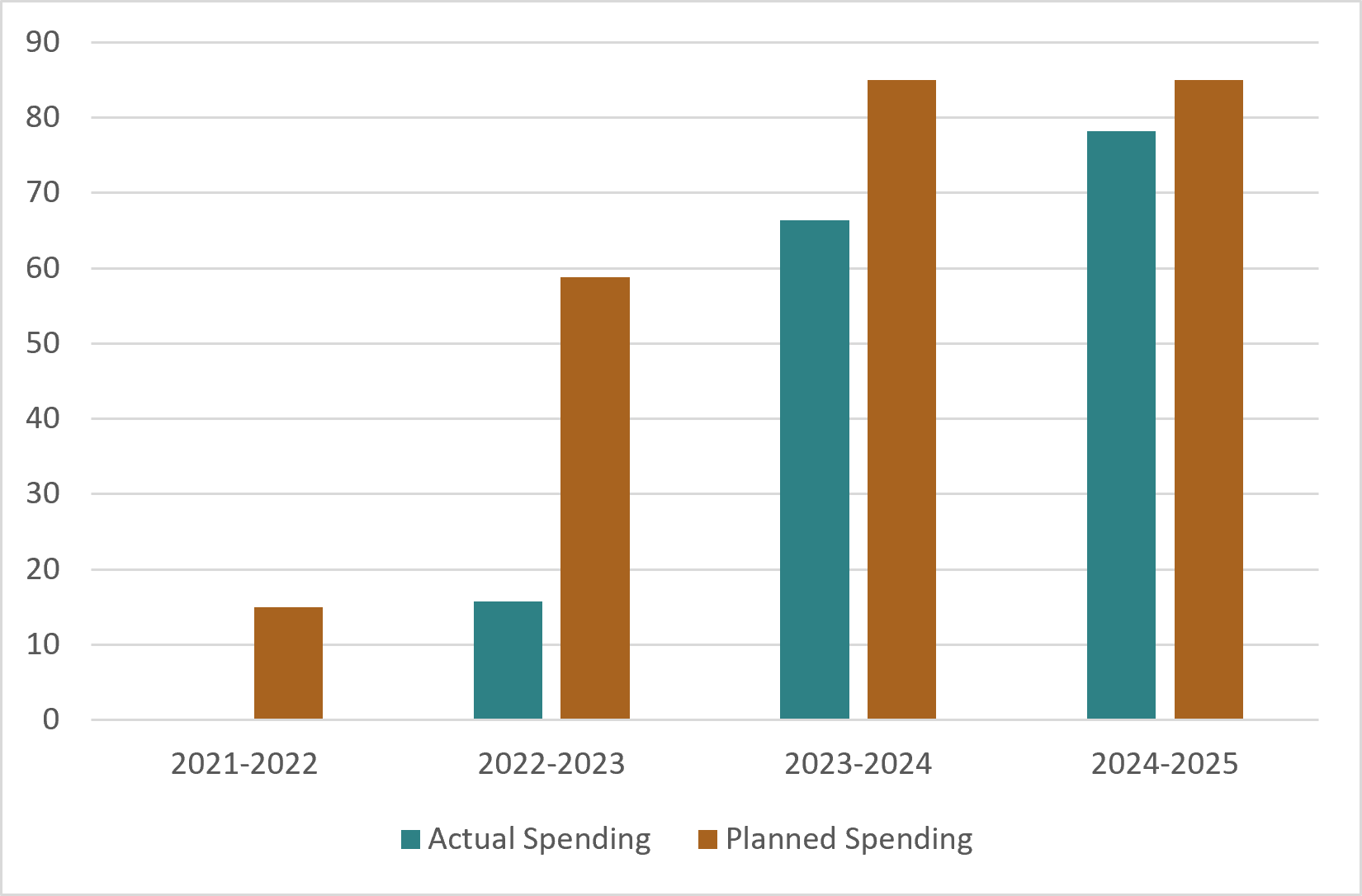
Figure 1: Image description
This graph presents the planned versus actual spending on Grants and Contributions.
- In 2021-2022, planned spending was $15 million while actual spending was $0.
- In 2022-2023, planned spending was $58.8 million while actual spending was $15.7 million.
- In 2023-2024, planned spending was $85 million while actual spending was $66.4 million.
- In 2024-2025, planned spending was $85 million while actual spending was $78.2 million.
Funding administration
There were challenges with the restrictions placed on recipients' ability to carry forward unspent funds into subsequent fiscal years, as well as their ability to reallocate funds across categories. Indigenous communities were afforded more flexibility as per Treasury Board requirements. Extending this funding flexibility to other communities could have improved program implementation and addressed financial management challenges, however, when explored with Treasury Board, these adjustments were not approved.
Delays in payment processing created cash flow challenges for recipients with some reporting wait times of months due to financial approval backlogs. These delays, in some cases, hindered the timely implementation of project activities. Additionally, enhanced scrutiny of financial information also contributed to recipients, at times, needing to advance their own funding for extended periods while awaiting reimbursement.
In 2022-2023, PS exceeded its target of issuing a payment within thirty days at least 80% of the time, by issuing 85% of all payments within three days of receiving all required documentation. Performance declined in 2023-2024 however with only 38% of payment requests being processed within the service standard and remained low in 2024-2025 with only 33% of payment requests meeting the standard.
Burdensome reporting
Recipients reported burdensome and inconsistent reporting requirements, including misalignment with their internal reporting systems and timelines, unclear guidance, and evolving expectations which created administrative challenges and delays.
Financial reporting requirements in particular, were widely identified as a core implementation challenge particularly for recipients consolidating information from multiple ultimate recipients. In some cases, municipalities managed reporting from more than 10 ultimate recipients, many of whom had limited administrative capacity resulting in significant effort to reconcile financial information.
BSCF Renewal
In late March 2026, funding for the BSCF was renewed for an additional three years, extending from 2026-2027 to 2028-2029 and providing up to an additional $157.5 million to municipalities and Indigenous communities in need. This renewed funding will allow communities to continue to build on the achievements over the last five years, with the opportunity for previous agreements that expired on March 31, 2026, to be extended. The program will also work to use the targeted selection process to identify new recipients based on updated data.
With only days between the renewal announcement and the expiration of existing agreements on March 31, 2026, both the program and recipients were significantly impacted.
When the renewal funding was announced, PS staff began working with recipients to sign amended contribution agreements to extend their project duration through March 31, 2027. In three days, 61 amendments were signed, which included all agreements in the Pacific and Ontario regions. The remaining recipients were unable to sign amendments for a variety of reasons, including challenges aligning renewal with internal council approvals and insufficient time to extend programs. With funding anticipated to end, recipients had adjusted programming which may have included laying off staff, reducing available capacity for participants, and making other adjustments that would need to be readjusted with further funding.
As experienced with the initial announcement of the BSCF in 2021-2022, the timing of the announcement may result in significant lapses in funding the first year as the program works with recipients to sign contribution agreements. Additionally, announcing the extension days before the end of the initial funding resulted in inefficiencies for recipients who will have to use resources to reinitiate programming.
Conclusions
There is a continued need for funding to address gun and gang violence in communities throughout Canada, as data demonstrates that firearm-related violent crime had been increasing until recently and funding for prevention related activities in municipalities and Indigenous communities is limited.
While the BSCF is distinct in its direct targeted funding to municipal governments and Indigenous communities, there are similarities among crime prevention programs within PS and efficiencies may be found in consolidation or collaboration. In particular, there may be opportunities to enhance reach to Indigenous communities through more formal connections with ACSPI during the selection process.
Municipalities and Indigenous communities leveraged BSCF funding in a variety of ways with many reporting success in addressing gun and gang violence among youth. BSCF funding also facilitated partnerships within communities and recipients developed and participated in communities of practice that guided their work. Some recipients identified a role for PS in facilitating early engagement and connectivity among recipients.
BSCF reached priority populations through targeted program design and projects with a focus on youth and other groups at heightened risk of gun and gang involvement. Projects identified and addressed barriers to participation which supported more accessible and inclusive program delivery.
While the program aims to encourage sustainability in projects following BSCF funding, only 10% of communities were able to confirm that the activities would continue once funding ended in March 2026. However, the program has since been renewed until 2028-2029 to allow existing communities to continue to build on their achievements, as well as identify new communities that are at greatest risk of gang-related firearm violence.
The effectiveness of the targeted funding model was diminished by limited consultation and delays to the initiation of the program, particularly the timing of approval and announcement, which compressed implementation timelines and influenced early program delivery. Greater engagement with PTs and regional advisors could have led to a strengthened selection process. Additionally, with funding not fully available on schedule and difficulties with burdensome and inconsistent reporting requirements, administrative challenges constrained timely implementation of contribution agreements.
Considerations
As the BSCF was renewed for a shortened time period, and given that the federal government is undergoing a comprehensive expenditure review, and PS is in the process of consolidating Grants and Contributions programs, the following considerations may serve to inform ongoing and future departmental activities and initiatives.
- There is an opportunity for PS to enhance collaboration and integration across internal crime prevention programs.
- PS could consider enhancing the selection process for future targeted programming by incorporating qualitative measures and consultations.
- There is an opportunity for PS to play a leadership role in the coordination and facilitation of communities of practice across recipients.
Annex A – Financial data table
| Year | Planned Spending ($000s) | Actual Spending ($000s) | Variance ($000s) | % Planned Budget Spent | ||||||
|---|---|---|---|---|---|---|---|---|---|---|
| Salary | O&M | Gs&Cs | Total | Salary | O&M | Gs&Cs | Total | |||
| 2021-2022 | 2,601 | 194 | 15,000 | 17,795 | 629 | 15 | - | 644 | 17,151 | 4 |
| 2022-2023 | 2,601 | 194 | 58,750 | 61,545 | 1,873 | 28 | 15,728 | 17,629 | 43,916 | 29 |
| 2023-2024 | 2,601 | 194 | 85,014 | 87,809 | 1,980 | 25 | 66,389 | 68,394 | 19,415 | 78 |
| 2024-2025 | 2,465 | 185 | 85,014 | 87,664 | 1,703 | 26 | 78,191 | 79,920 | 7,744 | 91 |
| 2025-2026 | 2,465 | 185 | 58,035 | 60,685 | 1,704 | 21 | 56,327 | 57,422 | 3,263 | 95 |
| Total | 12,733 | 952 | 301,813 | 315,498 | 7,259 | 115 | 216,635 | 224,009 | 91,489 | 71 |
- Date modified: