2026 Evaluation of the Biology Casework Analysis Contribution Program
Table of contents
Background
The Government of Canada established the Biology Casework Analysis Contribution Program (BCACP) in 2010 after a review of DNA forensic laboratory services costs and capacities. The overall objective of the BCACP is to provide financial contributions to Ontario and Québec for their forensic laboratories in order for them to help populate the Crime Scene Index (CSI) of the National DNA Data Bank (NDDB).
The NDDB was established in 2000 and is maintained by the Commissioner of the Royal Canadian Mounted Police (RCMP). It provides law enforcement and other members of the criminal justice system with a national collection of DNA information to be used in criminal investigations and prosecutions. The NDDB also houses indices with DNA profiles used for humanitarian purposes, such as identification of missing persons or human remains.
Three forensic laboratories are authorized to provide DNA profiles to the NDDB: the Ontario Centre of Forensic Sciences (CFS), the Laboratoire de sciences judiciaires et de médecine légale du Québec (LSJML), and the RCMP National Forensic Laboratory Services (NFLS). The CFS and LSJML are responsible for processing DNA samples from within their jurisdictions.
The 11 other Canadian provinces and territories have cost-sharing agreements with the RCMP through the Biology Casework Analysis Agreements (BCAA) for the collection and analysis of DNA from crime scenes at the NFLS.
Funding provided through the BCACP from Public Safety Canada increased from $3.45 million in 2020-2021 for both Ontario and Québec, to $7.1 million for CFS and $5.55 million for LSJML in 2024-2025. A larger share of the additional funding is allocated to Ontario which aligns with its higher demand for DNA analysis.
Engagement purpose and methodology
The purpose of the evaluation was to assess the effectiveness, efficiency and relevance of the Biology Casework Analysis Contribution Program. The evaluation covered the period from fiscal year 2020-2021 to 2024-2025 and was conducted in accordance with the Treasury Board Policy onResults and the Directive on Results. This evaluation is required under section 42.1 of the Financial Administration Act.
Interviews
Nine key informant interviews were conducted with Public Safety Canada staff and management, external partners and funding recipients.
Literature and program document review
A document review was conducted using relevant data and documents from the Crime Prevention Branch and the Programs Branch, as well as government reports.
Performance and financial data
Available performance data was reviewed and program financial data was analysed.
Limitations
Some performance data was unavailable at the time of the evaluation. The most recent data available is included in the report.
Findings
Effectiveness
Increased laboratory capacity
Finding: The increase in BCACP funding during the evaluation timeframe increased the capacity of the laboratories to hire additional staff, which has led to an increase in the number of DNA samples accepted and profiles uploaded to the NDDB.
The increase in BCACP funding in the most recent contribution agreements allowed the laboratories to hire additional staff. The LSJML increased their staffing numbers from 78 in 2022-2023 to 92 in 2023-2024. While specific numbers were not provided, the CFS had approval for an additional 25 staff and were working to complete staffing actions as of October 31, 2025. The additional staff has increased the laboratories' capacity to receive and analyse DNA samples and upload DNA profiles to the NDDB.
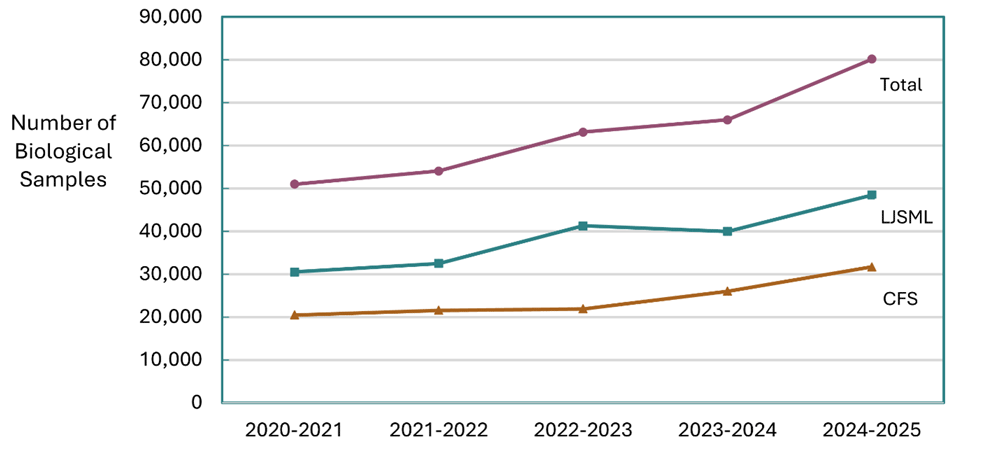
As seen in Graph 1, the total number of biological samples submitted to the CFS and LSJML laboratories for analysis has increased each year since 2020-2021.
Graph 1: Image description
The line chart displays the number of biological samples submitted yearly from 2020-2021 to 2024-2025 to the CFS, the LJSML, and a total of the two.
Number of biological samples submitted to the CFS:
- In 2020-2021, 20,490 samples were submitted to the CFS
- In 2021-2022, 21,572 samples were submitted to the CFS
- In 2022-2023, 21,901 samples were submitted to the CFS
- In 2023-2024, 26,032 samples were submitted to the CFS
- In 2024-2025, 31,700 samples were submitted to the CFS
Number of biological samples submitted to the LJSML:
- In 2020-2021, 30,506 samples were submitted to the LJSML
- In 2021-2022, 32,490 samples were submitted to the LJSML
- In 2022-2023, 41,266 samples were submitted to the LJSML
- In 2023-2024, 39,990 samples were submitted to the LJSML
- In 2024-2025, 48,480 samples were submitted to the LJSML
Total Number of biological samples submitted to the CFS and the LJSML:
- In 2020-2021, 50,996 samples were submitted to the CFS and LJSML
- In 2021-2022, 54,062 samples were submitted to the CFS and LJSML
- In 2022-2023, 63,167 samples were submitted to the CFS and LJSML
- In 2023-2024, 66,022 samples were submitted to the CFS and LJSML
- In 2024-2025, 80,180 samples were submitted to the CFS and LJSML
The increased number of samples analysed led to an increase in the number of DNA profiles uploaded to the NDDB. In 2024-2025, the BCACP-funded laboratories uploaded 15 075 DNA profiles to the Crime Scene Index (CSI) of the NDDB, a 84% increase from the 8 202 profiles uploaded in 2020-2021.
With the increased submissions from the CFS and LSJML, as of March 31, 2025, there were over 700 000 DNA profiles in the criminal indices of the NDDB. Of these, one-third are in the CSI while the other two-thirds were in the Convicted Offenders Index.
The total number of DNA profiles in the CSI of the NDDB from all three forensic DNA laboratories increased every year in the timeframe of the evaluation, but increased most significantly from 2023-2024 to 2024-2025, as seen in Table 1.
| Fiscal Year | Total number of DNA profiles in the CSI at year-end | Increase in CSI DNA profiles – Number | Increase in CSI DNA profiles – Percentage |
|---|---|---|---|
| 2020-2021 | 184 549 | 11 247 | 6% |
| 2021-2022 | 196 827 | 12 278 | 7% |
| 2022-2023 | 210 001 | 13 174 | 7% |
| 2023-2024 | 223 823 | 13 822 | 7% |
| 2024-2025 | 243 718 | 19 895 | 9% |
Timely and effective access
Finding: The Canadian criminal justice system generally has timely and effective access to the DNA analysis work of the funded laboratories and added to the NDDB, as seen by an increase in hits.
Funding provided through the BCACP aims to decrease processing turnaround times in both funded laboratories. Turnaround time is the time from when the case or request is received by the laboratory to when the DNA processing has been completed and the requestor notified. The requests could be for the investigation of a crime or for the prosecution of someone accused of a crime. Reduced turnaround times are important because they can reduce investigation time and potentially lead to criminals being apprehended sooner.
The LSJML improved their average turnaround time for all cases from 111 days in 2020-2021 to 62 days (decrease of 44%) in 2024-2025. They attributed the decreased turnaround time in large part to the additional funding they received from Public Safety Canada. In addition, the LSJML reported improvements in the percentage of requests they were able to complete within the 90-day standard. In 2020-2021, only 47% of requests for primary offences and 54% of requests for secondary offences were completed in less than 90 days. This improved to 83% of requests for primary offences and 93% of requests for secondary offences in 2024-2025.
The CFS reported that the additional funding from their most recent agreement allowed them to improve the turnaround time for their high-volume program made up of secondary offences, however they had more difficulties meeting the turnaround targets for prosecutorial requests.
Once a profile is uploaded to the NDDB it can be compared against other DNA profiles in the CSI, the Convicted Offenders Index, and other NDDB indices. When a match is made, this is considered a 'hit'. The work of the BCACP-funded laboratories has led to thousands of offender hits (match with a profile in the Convicted Offender Index) and forensic hits (match with another DNA profile in the CSI). This in turn supports organizations in the criminal justice system to perform their work efficiently and solve cases. One respondent noted that 38% of the DNA profiles they uploaded to the NDDB resulted in a hit to an offender, and another noted that 62% of the DNA profiles from their high-volume cases (such as break and enter, theft, and drug and weapon offences) resulted in hits.
Since 2000, DNA profiles uploaded from the three laboratories to the CSI of the NDDB resulted in almost 90,000 offender hits and over 10,000 forensic hits. The number of offenders and forensic hits from the DNA profiles uploaded from all three laboratories nearly doubled from 2020-2021 to 2024-2025.
| Fiscal Year | Offender Hits | Forensic Hits | Total Associations Made |
|---|---|---|---|
| 2020-2021 | 3 971 | 356 | 4 327 |
| 2021-2022 | 5 031 | 591 | 5 622 |
| 2022-2023 | 5 236 | 736 | 5 972 |
| 2023-2024 | 4 862 | 568 | 5 430 |
| 2024-2025 | 6 961 | 1 223 | 8 184 |
Efficiency
Coordination
Finding: While the BCACP-funded laboratories have shown the ability to implement new technology and analysis methods, they also work collectively with the RCMP lab to coordinate activities and share best practices.
The three public forensic DNA laboratories have worked together for many years and have developed strong working relationships. They jointly participate in working groups and committees such as the Public Safety Canada-led Federal-Provincial-Territorial DNA working group. All three laboratories share information and standardized operating procedures.
The BCACP-funded laboratories have also created training tools and provided training to law enforcement on the use of DNA technology which has helped improve the quality of DNA samples received for analysis. A number of examples of technological advancements in the field of DNA related analysis were identified as possibly having an impact on the capacity and resources of the BCACP funded laboratories. These included genetic genealogy, mitochondrial DNA testing and Rapid DNA. While advancements in the area of genetic genealogy have been credited with assisting in the resolution of serious crimes and cold cases there are challenges with the use of new and emerging technology. The laboratories have experienced delays in analyses when implementing new technology because of the training and familiarization required. There are some concerns with the increasing costs and training requirements, along with the unequal implementation of these technologies across the three forensic DNA laboratories. In particular, the LSJML laboratory has been identified as leading the way in forensic DNA analysis and adapting to new technologies, particularly in the area of genetic genealogy, where the DNA evidence in the NDDB is compared against DNA voluntarily submitted to private genetic services.
Funding arrangements
Finding: Public Safety Canada provides between 46% and 49% of the ongoing funding for the laboratories. Challenges with the funding model were identified.
Under the current funding agreement (in place until 2026-2027), the federal government through Public Safety Canada provides approximately 46% of the total funding for the Ontario laboratory and 49% of the total funding for the Québec laboratory. Under the previous funding arrangement (prior to 2022-2023), approximately 30% of the CFS funding came from the federal government, and 50% for the LSJML.
The RCMP is the main provider of forensic analysis in provincial jurisdictions that lack forensic laboratory capacity. Each jurisdiction has a Biology Casework Analysis Agreement (BCAA), negotiated by Public Safety Canada between the RCMP and the province or territory. According to the agreements established in 2014, the federal government covered 46% of the total costs associated with biology casework analysis, while the remaining 54% was distributed among jurisdictions based on their usage. This is in line with the current funding arrangements of the BCACP. It does however differ greatly from the existing contract policing agreements for RCMP services signed in 2012. Within those agreements, valid until 2032, the Government of Canada pays between 10% and 30% of the policing costs of contract jurisdictions depending on the population size.
While Public Safety Canada is responsible for negotiating both the BCAAs and the contract policing arrangements, they are not responsible for the financial aspects of either arrangement. This differs from the BCACP where Public Safety Canada has been responsible for the transfer payments since its establishment in 2010. Some respondents questioned whether this was an appropriate role for Public Safety Canada as they are not involved in the management of the NDDB.
Challenges with the current funding model were identified. The short-term nature of the funding agreements, and the delays with renewal in 2022, were highlighted as causing difficulties in resource planning for the laboratories. There were also significant delays in payments to the laboratories in the first year after the agreements were signed. While this has been resolved, the reporting requirements were seen as burdensome and in some instances the usefulness of the reporting was arguable. The reporting templates did not always reflect the work of the laboratories and it was not apparent how the reports were used.
Relevance
Finding: There is a continued need for the services provided by the laboratories receiving BCACP funding.
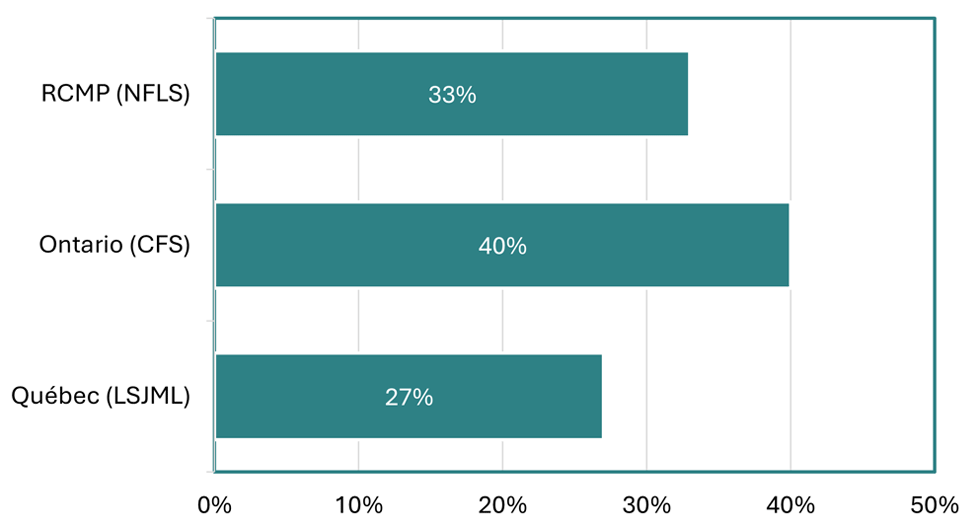
The laboratories receiving BCACP funding contribute to the NDDB and as a result support the Canadian criminal justice system. Within the NDDB, two-thirds of the DNA profiles in the CSI had been submitted by the provincial laboratories as of March 31, 2025.
Graph 2: Image description
The horizontal bar graph displays the percentage of all DNA profiles submitted to the NDDB as of March 31, 2025 by the RCMP (NFLS), Ontario (CFS), and Québec (LSJML).
- 33% of DNA profiles were submitted by the RCMP (NFLS) to the NDDB
- 40% of DNA profiles were submitted by Ontario (CFS) to the NDDB
- 27% of DNA profiles were submitted by Québec (LSJML) to the NDDB
The NFLS, CFS, and LSJML are the only forensic DNA laboratories authorized to upload DNA profiles to the NDDB. The RCMP NFLS does not have the current capacity to analyse the samples from police of jurisdiction within Ontario and Québec in addition to the samples from the other provinces and territories and relies on the support from the CFS and LSJML. While certain police forces have been utilizing privately-owned laboratories, those laboratories are not authorized to upload profiles to the NDDB and therefore cannot be compared with the existing indices, limiting their usefulness.
Conclusions
Overall, there is a continued need for the services of the BCACP-funded laboratories. The laboratories contribute to the NDDB, with two-thirds of the DNA profiles in the CSI having been submitted by the provincial laboratories as of March 31, 2025. This helps law enforcement investigate crimes in a timely manner, as DNA can be critical evidence in prosecution. The number of hits, or matches, between the DNA profiles in the NDDB have nearly doubled from 2020-2021 to 2024-2025, underscoring the impact the work of the CFS, LSJML, and NFLS have had on the criminal justice system.
The additional funding through the program was credited by both the LSJML and the CFS with increasing their capacity, including reducing their turnaround times and improving their ability to complete requests within the targeted service standard time.
Public Safety Canada provides approximately half of the ongoing funding for the Ontario and Québec laboratories, which is in line with the RCMP funding model for the Biology Casework Analysis Agreements, but differs from the contract policing agreements. Some respondents questioned if the role of funder was an appropriate role for Public Safety Canada as they are not involved in the management of the NDDB.
The laboratories reported challenges with the funding model, including the short-term nature of agreements, delayed renewals and payments, and burdensome reporting requirements.
Recommendation
The Senior Assistant Deputy Minister, Crime Prevention Branch should:
- Reexamine the funding model for the BCACP to determine the appropriate funding mechanism prior to the end of the existing agreements in March 2027
Management action plan
The Crime Prevention Branch (CPB), in consultation with the Emergency Management Branch (EMB) and the Corporate Management Branch (CMB), will undertake the following actions to address this recommendation:
- CPB will conduct an options analysis of available funding mechanisms (i.e. transfer payments) to identify alternate options. CPB will prepare recommendations for PS senior management on recommended approach to fund the current recipients (ON and QC) in upcoming years
- Planned Completion Date: July 2026
- Should a decision be made to seek a new funding approach, CPB will prepare the ask(s) to seek (on an as-required basis) new authorities (from Cabinet and/or TB)
- Planned Completion Date: December 2026
- Date modified: